
Quick Summary
Standard homeowners insurance water damage coverage applies strictly to sudden and accidental failures like burst pipes, while excluding gradual leaks, deferred maintenance, and standard sewer backups. Securing immediate emergency mitigation and certified psychrometric documentation through Floodline Restoration Co. protects your payout by verifying the loss is fresh and fulfilling your policy's required duty to mitigate. Homeowners will understand how to navigate policy limits and can contact 24/7 dispatch for rapid water extraction, structural drying, and adjuster-ready claim documentation.
Homeowners Insurance Water Damage: Fast Claims & Restoration
When an upstairs supply line snaps or a sewer line backs up into your basement, the clock starts ticking against your property and your insurance claim. Water spreads horizontally across subfloors and wicks upward through drywall within minutes. Standard homeowners policies generally pay for the emergency cleanup and structural repairs caused by sudden internal plumbing failures, but carriers strictly exclude long-term maintenance issues, slow seepage, and overland floodwaters.
Floodline Restoration Co. provides emergency water extraction, structural drying, and claim documentation throughout Canarsie and surrounding Brooklyn neighborhoods. Our IICRC-certified crews arrive with commercial extraction equipment, moisture meters, and daily logging tools to protect your home and supply the proof your insurance adjuster needs.
Does Homeowners Insurance Cover Water Damage? Quick Coverage Guide
Quick Coverage Guide: Homeowners insurance covers sudden and accidental water discharges, such as split supply lines, ruptured water heaters, frozen pipes, and appliance overflows. It excludes wear and tear, continuous slow leaks, ground seepage, and exterior coastal flooding. An approved claim pays for professional water extraction, structural drying, selective demolition, and rebuilding materials, subject to your deductible.
The distinction between covered and denied claims comes down to how the water escaped and how quickly you acted to stop it. If a pipe ruptures unexpectedly at 2:00 AM, the resulting structural drying and drywall repairs are typically covered. If water dripped behind a shower wall for eight months unnoticed, an adjuster will likely label the loss as rot or deferred maintenance and deny the payout.
Covered vs. Excluded Water Damage at a Glance
According to the Insurance Information Institute, water damage and freezing rank among the most common property damage claims, affecting roughly 1 in 67 insured homes each year. Policy language separates losses into distinct categories based on origin:[1]
| Source of Water Loss | Coverage Status | Policy Requirement & Scope |
|---|---|---|
| Burst supply line, frozen pipe, or water heater failure | Covered under standard HO-3 / HO-5 policies | Requires a sudden, accidental failure; covers extraction, drying, and structural repairs (not the failed pipe itself). |
| Slow plumbing leak inside a wall or subfloor | Excluded | Classified as maintenance neglect or gradual deterioration occurring over weeks or months. |
| Municipal sewer backup or failed sump pump | Excluded on basic policies (Covered with Rider) | Requires a specific Water Backup and Sump Discharge endorsement added to your policy. |
| Coastal storm surge, overflowing basin, or street runoff | Excluded on standard homeowners policies | Requires a separate National Flood Insurance Program (NFIP) or private flood policy. |
Key Steps to Protect Your Claim Immediately
In attached brick homes, brownstones, and split-level properties, water quickly travels through shared floor joists and party walls. Follow these steps to secure your living space and satisfy your policy duties:
- Shut off the main water valve: Stop the flow at the source before inspecting the area.
- Call certified emergency restoration: Have professional technicians arrive on-site with calibrated moisture meters to establish baseline readings before structural materials begin to decay.
- Take initial photo and video records: Record standing water levels, saturated baseboards, wet furniture, and damaged mechanical equipment before anything gets moved.
- Secure independent psychrometric logs: Obtain temperature, relative humidity, and moisture content logs from your restoration contractor to prove the loss is fresh, preventing the insurer from claiming pre-existing wear.
- Notify your insurance carrier: Open the claim with your initial policy details, stating the exact time the incident occurred.
What Does Homeowners Insurance Water Damage Cost?
Need homeowners insurance water damage?
We’re available now - call for a fast, free estimate.
Water damage represents a massive financial exposure for property owners. The Insurance Information Institute reported an average claim cost of $15,400 for water damage and freezing between 2019 and 2023, with water-related losses making up 22.6% of all homeowners claims in 2023. Historical data compiled by the Texas A&M Real Estate Center also highlighted water damage and freezing as the second leading cause of property claims, showing an average paid loss of $11,097 in 2021.[2]
These expenses continue to climb. A 2025 LexisNexis report found that weather-related water loss costs climbed 25.4% from 2023 to 2024 alone. While overall claim frequency dipped 3.2%, claim severity surged 29.6%, driven by higher labor rates, expensive building materials, and complex structural repairs in urban environments.
Understanding Deductibles and Mitigation
Professional water mitigation costs typically range from $3.50 to $7.00 per square foot for clean water extraction and $7.00 to $12.00+ per square foot for contaminated or black water losses. How your payout is handled comes down to three mechanics:
- Your Policy Deductible: You pay your set deductible (typically $1,000 to $2,500) directly toward the initial mitigation or repair invoices. The insurance carrier pays approved amounts above this threshold.
- Direct Insurance Billing: Standard restoration contractors use Xactimate, the same pricing software adjusters rely on, itemizing equipment hours, air mover placements, and antimicrobial treatments according to regional price indices.
- Emergency Mitigation Budgets: Most standard policies contain a reasonable repairs clause authorizing immediate emergency spending to stop secondary loss, even before an adjuster steps foot on the property.
Why Documenting Damage Promptly Protects Your Claim
Every homeowners policy contains a strict “duty to mitigate” clause. This provision requires property owners to take fast, reasonable steps to stop water from spreading and causing secondary rot, warping, or microbial growth. If you wait days for an insurance adjuster to visit before starting water extraction, the carrier can legally deny portions of your claim based on failure to mitigate.
The Risk of Gradual Damage and Failure to Mitigate
Calling an insurance claims hotline before bringing in an independent restoration crew can put your payout at risk, particularly in older urban properties. When an adjuster arrives days after an incident without prior psychrometric documentation, they look for water stains, rusted framing nails, or early mold growth. Without verified data proving that saturation happened hours earlier, field adjusters frequently invoke standard policy exclusions for gradual damage, continuous seepage, or neglect.
As documented by Floodline Restoration Co., independent, timestamped psychrometric logs record relative humidity, ambient temperature, dew points, and grains per pound (GPP) from day one. These readings demonstrate that your materials suffered sudden saturation rather than long-term moisture exposure, protecting you against improper claim denials.
Documenting Property Damage
In multi-family dwellings and attached row houses, water rarely stays confined to one room. A complete documentation file should include:
- Non-Invasive Moisture Mapping: Infrared thermal cameras and pinless meters that track water migration behind plaster, beneath tongue-and-groove hardwood, and inside party wall cavities.
- Daily Psychrometric Records: Morning and evening readings showing the exact rate of moisture extraction from concrete slabs, wall studs, and joists.
- Itemized Loss Inventory: Categorized photo logs of non-salvageable structural materials, warped baseboards, and ruined personal property ready for adjuster review.
Drywall, Ceilings, and Shared Wall Cavities: Repair vs. Replace
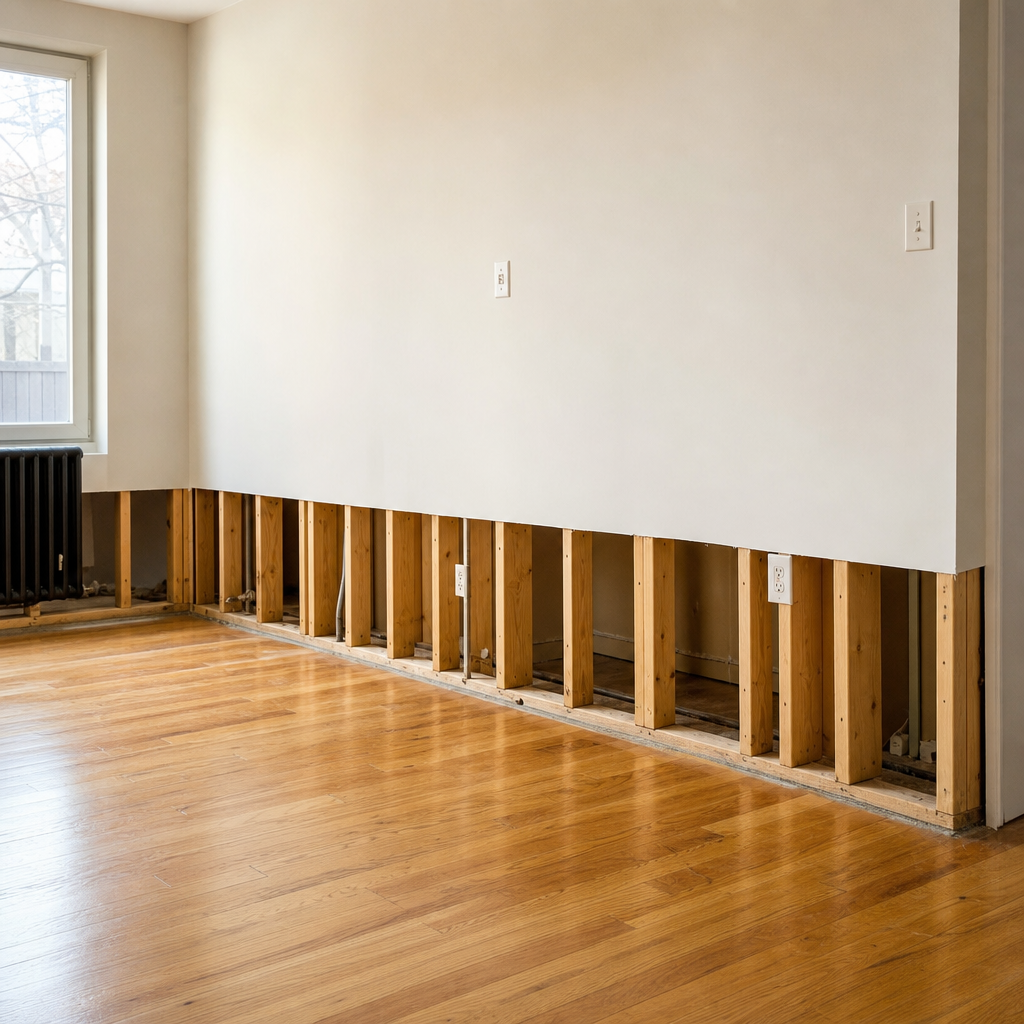
Drywall loses its structural integrity quickly when wet, while older plaster can hold gallons of water before suddenly collapsing. Determining whether to dry in place or tear out saturated building materials depends on water cleanliness and the duration of exposure.
Symptoms of Hidden Moisture Behind Plaster and Drywall
Trapped moisture within wall cavities shows clear warning signs: bubbling paint, soft or crumbling plaster, discolored baseboards, and a sharp musty odor. In attached brick buildings near Paerdegat Basin or Flatlands Avenue, moisture trapped in wood lath behind plaster will quickly cause fungal growth if air is not forced through the structural cavities.
When Structural Tear-Out Is Covered by Insurance
Insurance coverage includes selective demolition (flood cuts, removing wet insulation, and pulling drywall 12 to 24 inches above the water line) whenever materials cannot be safely dried to industry standards. Clean supply-line water on standard gypsum board can sometimes be dried in place if addressed within 24 hours. If water came from a contaminated source or remained trapped long enough to deteriorate the gypsum core, the policy pays for full removal and replacement.
Hardwood Floors, Subfloors, and Joists: Saving Structural Flooring
Need homeowners insurance water damage?
We’re available now - call for a fast, free estimate.
Solid oak, maple, and engineered hardwoods react aggressively to standing water. Water gets trapped between the finish floor and the subfloor plywood, creating a moisture sandwich that standard room fans cannot dry.
Identifying Cupping, Crowning, and Delamination
Hardwood boards cup when the bottom of the plank absorbs more water than the top, causing the edges to curl upward. If dried too quickly from the top with heat, the boards can crown, swelling in the center. Engineered floors exposed to standing water will delaminate, causing the top veneer to separate permanently from the backing plies.
Insurance Standards for Subfloor and Joist Restoration
Insurers cover the cost of specialized drying mats and negative-pressure injection systems designed to pull moisture directly through the hardwood without tearing up original historic floors. When subfloors or heavy structural joists reach high moisture content, claims cover the drying time and any sistering or replacement required to restore the floor system to pre-loss condition.
Basement Water Extraction, Sewage Backup, and Mold Remediation Rules
Basements are vulnerable to severe water losses, particularly during heavy coastal storms or high tides around Jamaica Bay. Coverage for basement water depends entirely on where the water originated.
Water Categories and Safety
The IICRC defines water into three distinct categories:
- Category 1 (Clean Water): Originates from broken supply lines, failed sink faucets, or toilet tanks. Poses minimal immediate risk if extracted rapidly.
- Category 2 (Gray Water): Carries chemical or biological contaminants. Common sources include washing machine overflows, dishwasher discharge, and sump pump failures.
- Category 3 (Black Water): Highly hazardous water from sewage line backups, coastal storm surges, or river overflows. Contains dangerous bacteria and pathogens, requiring full containment, removal of all porous materials, and medical-grade antimicrobial sanitization.
Policy Endorsements for Sump Pump Failure and Sewer Backups
Standard homeowners insurance policies exclude drain backups, sump pump failures, and exterior rising floodwaters. To protect a finished basement, property owners must add a specific Water Backup and Sump Overflow endorsement to their policy, which usually provides $5,000 to $25,000 in dedicated coverage for cleanouts, extraction, and finished basement drywall repairs.
Homeowners Insurance Water Damage FAQs
Does homeowners insurance cover water damage from a broken pipe?
Yes. Standard homeowners insurance policies cover water damage resulting from a sudden, accidental plumbing rupture. This includes the cost of emergency water extraction, drying equipment, drywall removal, and reconstruction. The policy pays for the damage caused by the water, though the homeowner usually covers the plumbing repair on the pipe itself.
What types of water damage are not covered by homeowners insurance?
Policies exclude gradual damage (leaks running for weeks or months), wear and tear, ground seepage through foundation walls, sewer backups (without an endorsement), and coastal storm flooding. Damage resulting from unheated properties where pipes froze due to homeowner negligence is also routinely denied.
How do I file a water damage insurance claim step by step?
First, turn off your main water valve to stop the source. Second, call an IICRC-certified restoration company like Floodline Restoration Co. for emergency mitigation and independent psychrometric moisture mapping. Third, document all affected rooms and belongings with photos and video. Fourth, call your insurance carrier to file the claim, providing your restoration contractor’s itemized documentation and dry logs.
Does insurance pay for emergency water extraction and restoration services?
Yes. Under the policy mitigation clause, insurers cover professional emergency water extraction, structural drying, and sanitization services to prevent further loss. Restoration contractors submit standardized, line-item estimates directly to your adjuster for approval.
What is the average payout for a water damage insurance claim?
Industry data from the Insurance Information Institute shows the average water damage and freezing claim cost $15,400 between 2019 and 2023. Final payouts depend on the water category, total square footage affected, whether subfloors or structural framing require replacement, and your policy deductible.[3]
Is gradual water damage or secondary mold covered by standard policies?
Standard homeowners policies exclude gradual leaks and long-term rot. Secondary mold remediation is typically capped at low limits (often $5,000 to $10,000) or excluded entirely unless it directly resulted from a documented, sudden covered loss that was mitigated immediately.
What areas does Floodline Restoration Co. serve?
Our rapid-response emergency crews provide 24/7 water extraction, structural drying, and insurance claims assistance across Canarsie, Flatlands, Bergen Beach, Marine Park, Mill Basin, and surrounding Brooklyn neighborhoods.
Need homeowners insurance water damage?
We’re available now - call for a fast, free estimate.
Sources
- Water Damage Insurance Claims Statistics (2026) – consumeraffairs.com (2026)
- Does Homeowners Insurance Cover Water Damage? – NerdWallet – nerdwallet.com (2026)
- The Rising Cost of Water Damage in American Homes in 2026 – thesource.com (2026)
Related reading: Water Mitigation Cost – Call Now-10% Off – Same-Day Service – Free Estimate
Related reading: Sewage Cleanup Cost | 10% Off & Free Estimate | Same-Day Service
Related reading: Sewage Backup Cleanup Cost – 10% Off & Free Estimate – Same-Day Service
Frequently Asked Questions
How do psychrometric drying logs prevent an insurer from denying a water damage claim?
Psychrometric logs track real-time moisture levels, grains per pound (GPP), and relative humidity to prove saturation occurred suddenly rather than from prolonged leaks. Floodline Restoration Co. captures certified baseline data on day one, providing the definitive technical proof adjusters require to rule out pre-existing neglect or gradual wear.
Can I start emergency water extraction before an insurance adjuster inspects my home?
Yes, standard homeowners policies contain a mandatory duty to mitigate clause that requires policyholders to halt active water migration immediately. Calling Floodline Restoration Co.'s 24/7 dispatch allows certified crews to begin extraction and non-invasive moisture mapping right away, fulfilling policy requirements while generating the photographic evidence needed for claim approval.
How does direct insurance billing work for emergency water damage restoration?
Certified restoration contractors generate itemized estimates using Xactimate, the standardized pricing software used across the insurance industry. Through structured claim documentation protocols like the Straight Claim Program at Floodline Restoration Co., all equipment logs and drying records are submitted directly to your adjuster, leaving you responsible only for your policy deductible.
About the author
 |
Sarah Miller Sarah Miller is a certified water damage restoration specialist with over eight years of experience serving the Canarsie, NY area. Holding a degree in Environmental Science from Brooklyn College, she specializes in emergency response protocols and navigating complex insurance claims for both residential and commercial properties. Her practical expertise helps property owners understand the nuances of restoration costs and effective prevention strategies. |
Water damage, flood, or mold emergency?
We’re available now - call for a fast, free estimate.
Call Now - Free Estimate