
Quick Summary
Water mitigation costs typically range from $1,500 to $7,000, with expenses scaling based on water contamination levels, structural material porosity, and the speed of emergency response. To prevent runaway expenses and hidden fees, Floodline Restoration Co. provides transparent upfront pricing, detailed moisture documentation, and direct insurance billing through standardized industry scopes. After reviewing this guide, property owners will understand critical cost drivers and can contact the 24/7 dispatch team to secure a free visual inspection and an upfront mitigation estimate.
Water Mitigation Cost: Upfront Pricing Without Hidden Fees
According to external market estimates, most residential water mitigation costs range between $1,500 and $7,000, with the average water damage restoration project costing $3,869. When water suddenly floods your property, whether from a frozen pipe burst in winter or a coastal storm surge pushing up from Jamaica Bay, getting qualified technicians on site quickly is the single biggest factor in preventing a minor cleanup from turning into a massive rebuild. Data from the Insurance Information Institute shows that the average water damage and freezing claim reached $13,954 between 2018 and 2022, primarily because delayed response allowed standing water to saturate framing, subfloors, and wall cavities.
When dealing with standing water in your home or commercial building, you need straight answers on pricing rather than surprise emergency fees, as emphasized by Floodline Restoration Co. A dependable restoration team should provide a rapid physical inspection, an itemized scope of work, real-time moisture logs, and direct coordination with your insurance adjuster. Below is a realistic breakdown of water mitigation pricing, how service tiers differ, and what property owners in attached urban homes must watch out for to prevent runaway expenses.
How Much Does Water Mitigation Cost on Average?
Average Water Mitigation Cost at a Glance: Standard water damage restoration costs typically range from $450 to $16,000, averaging $3,869 according to Angi data. Emergency water extraction alone generally runs between $3.00 and $7.50 per square foot, depending on the contamination level and affected materials.[3]
The total bill for a water emergency splits into two distinct phases: emergency mitigation (stopping water, extracting standing pools, and drying the structure) and structural restoration (repairing or replacing ruined drywall, flooring, and cabinetry). Water damage restoration costs average $3,869, with overall restoration and repair projects falling within the verified range of $450 to $16,000 depending on the scope of work.
Online square-footage calculators frequently produce inaccurate estimates for urban and coastal residences. In attached brick and wood-frame structures common throughout Brooklyn, water does not stay confined to one footprint. Moisture wicks horizontally through shared party-wall cavities into neighboring framing. If a contractor estimates a job purely by the visible square footage of the wet floor without scanning the party walls with thermal imaging, unaddressed moisture will spread, leading to structural rot and multi-unit liability.
Immediate Action: What Happens in the First 24 to 48 Hours
Starting extraction within the first 24 to 48 hours is vital to stop mold spores from establishing colonies and to prevent wooden studs from swelling. A standard emergency mitigation deployment involves three steps:
- Rapid Water Extraction: Truck-mounted or heavy-duty portable extraction units remove standing water from floors and carpets to halt immediate saturation.
- Structural Drying and Dehumidification: Low-grain refrigerant (LGR) dehumidifiers and high-velocity air movers pull trapped water vapor out of subfloors, base plates, and wall cavities.
- Antimicrobial Application: EPA-registered sanitizing treatments are applied across affected surfaces to eliminate bacteria and stop fungal growth.
Water Mitigation vs. Water Damage Restoration Costs
Cost references such as Angi clearly separate mitigation from general reconstruction. As outlined by Floodline Restoration Co., mitigation encompasses the immediate labor and equipment needed to stabilize the property and bring moisture levels back to dry standards. Reconstruction is a separate phase that covers trade labor for hanging new drywall, installing trim, laying new subflooring, or replacing structural joists. Understanding this distinction helps property owners review estimates clearly and ensures each line item matches insurance claim categories.
What Does Water Mitigation Cost? Full Breakdown by Service
Need water mitigation cost?
We’re available now - call for a fast, free estimate.
Emergency mitigation pricing scales based on the cleanliness of the water source, how long the water has sat, and how deeply it has penetrated structural layers. Contaminated water demands strict protective measures, specialty disposal, and aggressive sanitization, which increases labor and disposal costs.
| Service Attribute | Category 1: Clean Water | Category 2: Gray Water | Category 3: Black Water |
|---|---|---|---|
| Avg. Mitigation Range | $1,500 – $3,000 | $2,500 – $5,000 | $4,000 – $10,000+ |
| Extraction Rate / Sq. Ft. | $3.00 – $4.50 | $4.50 – $6.00 | $6.00 – $7.50 |
| Porous Material Removal | Rarely required | Cushioning / Carpet Pad | Full tear-out of porous items |
| Sanitization Protocol | Standard airflow & monitoring | Targeted antimicrobial wash | Biohazard containment & disposal |
Emergency Water Extraction Cost per Square Foot
Expect extraction rates between $3.00 and $7.50 per square foot. Lower rates apply to shallow, clean water sitting on concrete or resilient tile floors. The cost rises when extracting contaminated water or drawing moisture out of deep commercial carpet, hardwood planks, or layered subflooring that requires specialized vacuum-mat drying panels.
Water Category Pricing: Clean, Gray, and Black Water
The water source establishes the safety standards and remediation steps technicians must follow under IICRC guidelines:
- Category 1 (Clean Water): Originates from broken supply lines, failed faucet fittings, or clean sink overflows. It carries no immediate health risk and requires standard extraction and drying equipment.
- Category 2 (Gray Water): Comes from washing machine overflows, dishwasher discharge, or sump pump failures. It contains biological or chemical contaminants, requiring the removal of carpet padding and application of antimicrobial agents.
- Category 3 (Black Water): Involves sewer backups, toilet overflows containing feces, or coastal floodwater from storm surges. It contains hazardous pathogens and requires full personal protective equipment (PPE), controlled removal of saturated drywall, and strict biohazard waste disposal.
According to National Flood Insurance Program (NFIP) data tracked by iPropertyManagement, the average flood claim payout reached $52,000 in 2025.[1]
Key Property Components: Drywall, Subfloors, and Basements
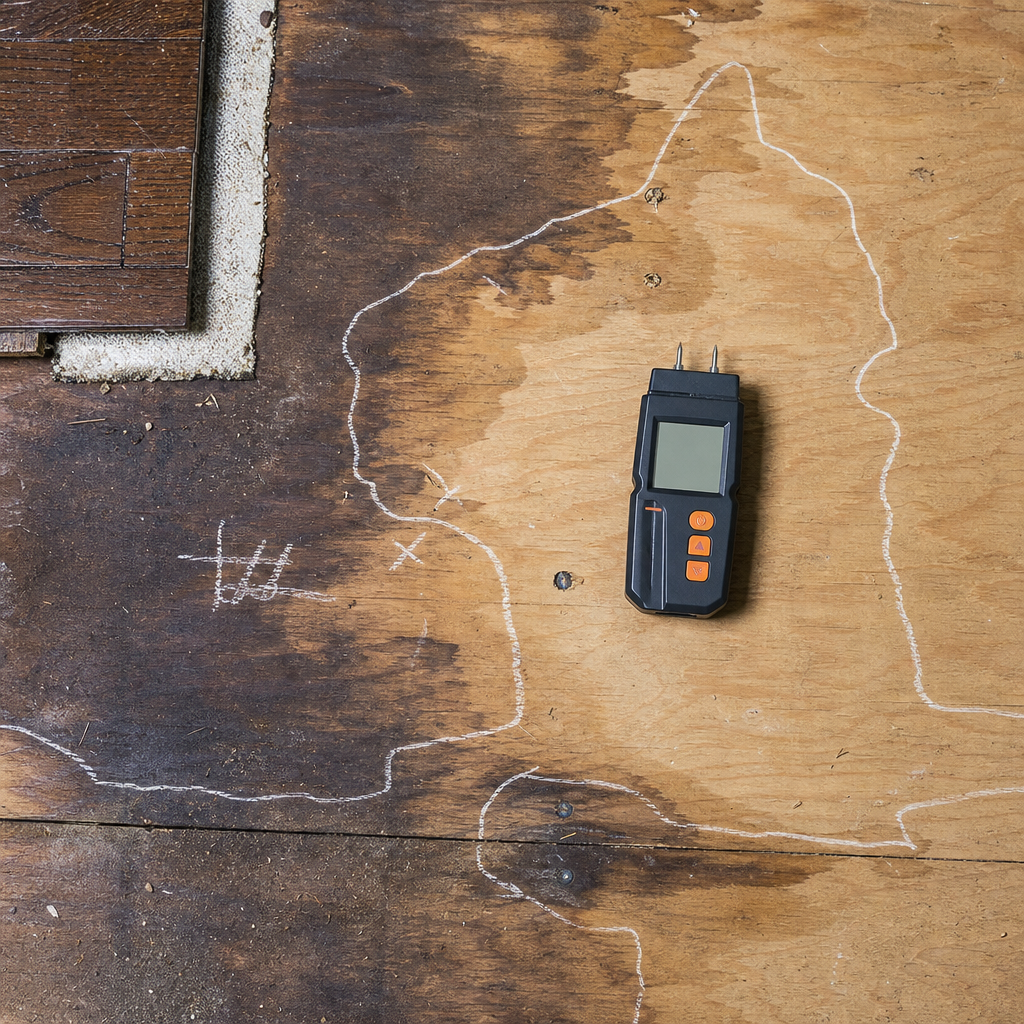
Mitigation costs depend on the porosity of the materials involved and how easily air can circulate through damaged spaces. Wet drywall, multi-layer plywood subfloors, and finished basements present unique challenges that determine whether components can be dried in place or must be cut out and discarded.
Drywall and Shared Party-Wall Cavities in Urban Homes
Standard square-foot pricing models regularly fall short when applied to attached properties such as brownstones or rowhouses. In these buildings, water seeping into a perimeter wall does not just sit in one room; it wicks sideways through shared plaster, lathe, or drywall assemblies into the adjacent property. IICRC-certified technicians, including specialists at Floodline Restoration Co., use non-invasive moisture meters and thermal imaging cameras to track this hidden lateral movement, opening controlled air gaps at the baseboards to dry shared cavities before moisture triggers structural mold across property lines.
Subfloor and Joist Structural Drying vs. Replacement
Moisture trapped beneath finish flooring must be addressed quickly to prevent the need for expensive structural rebuilds:
| Component | Restorative Drying (Keep) | Controlled Removal (Replace) |
|---|---|---|
| Hardwood & Subfloor | Negative-pressure floor mat systems installed within 24 to 48 hours to reverse plank cupping. | Severe floor buckling, delaminated subfloor panels, or soft, rotted joists. |
| Insulation & Padding | Non-porous closed-cell spray foam (clean water events only). | All wet fiberglass batts, blown cellulose, and saturated carpet pads. |
| Base Cabinetry | Toe-kick ventilation holes paired with forced warm-air drying systems. | Swollen particle board bases or visible mold colonization on backer boards. |
Basement Water Mitigation and Sump Pump Failures
Basements in low-lying neighborhoods near Paerdegat Basin and Jamaica Bay face severe risks from elevated groundwater, heavy rainfall, and overloaded city sewer lines. NFIP assessments indicate that just one single inch of floodwater can cause approximately $27,000 in damage to an average residence. Fast pump-outs and immediate structural drying prevent floodwater from corroding boilers, hot water heaters, and electrical panels, keeping overall restoration expenses manageable.[2]
Does Homeowners Insurance Cover Water Mitigation Costs?
Need water mitigation cost?
We’re available now - call for a fast, free estimate.
Sudden and accidental water damage may be covered by standard homeowners insurance policies, while flood damage usually requires separate flood insurance.
Navigating Claims with Detailed Moisture Logs
Insurance adjusters demand objective, verifiable data before approving commercial drying charges. Reliable mitigation contractors like Floodline Restoration Co. record daily atmospheric readings (including relative humidity, temperature, and grains per pound) alongside thermal imaging scans and moisture-meter percentages. Providing these psychrometric drying logs directly to your carrier substantiates every air mover and dehumidifier used on the job, expediting claim payouts.
Avoiding Predatory Contractor Surcharges
Property emergencies can attract unscrupulous operators who quote low initial phone estimates only to add equipment rental surcharges, fuel fees, and after-hours penalties to the final invoice. Always demand a clear, written line-item scope that adheres to standardized industry pricing databases (such as Xactimate) before work proceeds.
Frequently Asked Questions About Water Mitigation
How much does water mitigation cost on average?
Water damage restoration costs range from $450 to $16,000, with an average cost of $3,869. External market estimates place standard emergency water mitigation between $1,500 and $7,000 depending on the severity of the water loss.
What is the difference between water mitigation and water damage restoration costs?
Mitigation covers the immediate emergency actions taken to prevent further destruction: pumping out water, drying wet materials, and sanitizing surfaces. Restoration covers the subsequent repair work, such as replacing damaged drywall, laying new carpet or hardwood, and rebuilding structural framing.
Does homeowners insurance cover water mitigation costs?
Sudden and accidental water damage may be covered under standard homeowners insurance, while flood damage usually requires separate flood insurance.
How much does emergency water extraction cost per square foot?
Emergency extraction typically costs between $3.00 and $7.50 per square foot. Clean water sitting on top of non-porous surfaces represents the lower end of the pricing scale, while contaminated sewage or deep saturation in complex flooring materials falls at the higher end.
How fast can an emergency water extraction crew arrive?
Professional emergency response teams maintain 24/7 live dispatch to extract standing water, contain property damage, and begin structural drying procedures promptly.
Are restoration technicians certified and insured?
Reputable restoration companies like Floodline Restoration Co. employ technicians certified by the Institute of Inspection, Cleaning and Restoration Certification (IICRC). Certified crews follow strict ANSI/IICRC S500 standards for professional water damage restoration to ensure properties are dried safely and thoroughly.
Need water mitigation cost?
We’re available now - call for a fast, free estimate.
Sources
- national flood insurance program – media toolkit – agents.floodsmart.gov (2024)
- [PDF] flooded (a report by fema) – Agents Floodsmart – agents.floodsmart.gov
- Water Damage Restoration Cost: 2026 Pricing Guide – pushleads.com (2026)
Related reading: Sewage Cleanup Cost | 10% Off & Free Estimate | Same-Day Service
Frequently Asked Questions
How does direct insurance billing work for water mitigation costs?
Floodline Restoration Co. uses the Straight Claim Program to bill your insurance carrier directly based on standardized Xactimate pricing. Technicians provide detailed psychrometric drying logs and thermal imaging to substantiate every charge, preventing unexpected out-of-pocket expenses beyond your deductible.
How can I get an accurate water mitigation estimate without hidden diagnostic fees?
You can contact the 24/7 dispatch team at Floodline Restoration Co. to schedule a free visual inspection. Certified technicians use thermal imaging and moisture meters to assess the structural damage and provide a comprehensive, upfront written scope before work begins.
How many days does structural water mitigation take, and does equipment run time increase the price?
Most residential drying projects require three to five days of continuous dehumidification and air movement to reach dry standards. Floodline Restoration Co. tracks daily moisture logs to pull equipment the moment materials are certified dry, preventing unnecessary rental fees.
About the author
 |
Sarah Miller Sarah Miller is a certified water damage restoration specialist with over eight years of experience serving the Canarsie, NY area. Holding a degree in Environmental Science from Brooklyn College, she specializes in emergency response protocols and navigating complex insurance claims for both residential and commercial properties. Her practical expertise helps property owners understand the nuances of restoration costs and effective prevention strategies. |
Water damage, flood, or mold emergency?
We’re available now - call for a fast, free estimate.
Call Now - Free Estimate