
Quick Summary
Residential water extraction costs typically range from $3.00 to $7.50 per square foot ($1,200 to $5,000 on average), with total expenses driven by water contamination categories, building materials, and response speed. Floodline Restoration Co. eliminates pricing guesswork and prevents costly structural tear-outs by delivering upfront written scopes, 45-minute emergency dispatch, and direct insurance billing via thorough moisture documentation. Readers will understand key cost variables across clean, gray, and black water emergencies and can contact Floodline Restoration Co.'s 24/7 live dispatch team for immediate mitigation or a free on-site visual inspection.
Water Extraction Cost: Upfront Pricing and Emergency Cleanup Guide
When unexpected water enters your home or commercial building, professional water extraction costs typically range from $3.00 to $7.50 per square foot for rapid pumping and structural drying. If standing water remains unaddressed and saturates framing, subflooring, or drywall, subsequent reconstruction costs can add another $20.00 to $37.00 per square foot. Every hour water sits inside structural assemblies, secondary damage drives the final bill higher.
At Floodline Restoration Co., we eliminate pricing ambiguity during an emergency by providing clear written scopes before mitigation starts. Our background-checked, IICRC-certified in-house technicians arrive on site within 45 minutes across Canarsie, Flatlands, and surrounding Brooklyn neighborhoods. Through our Straight Claim Program, our team documents moisture levels daily, photographs every affected room, and bills your insurance carrier directly to keep your out-of-pocket stress low. Call our 24/7 live dispatch team to request emergency water removal or to book a free on-site visual inspection.
Emergency Water Extraction Cost: Quick Pricing Breakdown
Professional water damage mitigation averages approximately $3,000 for standard residential projects, with most jobs landing between $1,200 and $5,000. Your total invoice depends on standing water depth, the classification of the water (clean supply lines versus contaminated floodwater or sewage), and how quickly technicians begin extracting moisture before it wicks deep into structural framing.[2]
Immediate Pricing Overview
Mitigation industry estimates place standard extraction and drying services between $3.00 and $7.50 per square foot. If structural materials require complete tear-out and rebuilding, secondary reconstruction ranges from $20.00 to $37.00 per square foot.
Key Variables Affecting Your Total Cost
The origin of the water dictates the labor, containment equipment, and antimicrobial products required. Clean water from an appliance supply line demands straightforward extraction and dehumidification. In contrast, Category 3 black water from a storm surge along Jamaica Bay or a municipal sewer backup requires specialized biohazard protocols, personal protective equipment, and regulated disposal, significantly raising your total mitigation cost.
What Does Professional Water Extraction Cost?
Need water extraction cost?
We’re available now - call for a fast, free estimate.
Most residential extraction and drying projects cost between $1,200 and $5,000, depending on square footage and contamination levels. Per-square-foot pricing generally follows standard industry tiers: clean water extraction ranges from $3.75 to $4.25 per square foot, gray water with light contaminants ranges from $4.10 to $6.50 per square foot, and heavily contaminated black water averages $7.00 to $7.50 per square foot.[1]
Standard Industry Price Ranges
It helps to know that reliable public data on residential water extraction is scarce, and most published numbers are private restoration market averages rather than official government statistics. In fact, official datasets like the Government of Canada Open Government Portal track industrial water acquisition and total water costs in mining and manufacturing, where “water extraction cost” describes commercial water-use permits rather than disaster cleanup. In residential and commercial property restoration, as technicians at Floodline Restoration Co. observe, your bill reflects specialized extraction machinery, psychrometric monitoring, technician labor hours, and rapid structural stabilization.
| Service Tier | Clean Water (Category 1) | Gray Water (Category 2) | Black Water (Category 3) |
|---|---|---|---|
| Common Sources | Supply line breaks, sink overflows | Washing machine discharge, sump pump failures | Sewage backups, coastal storm surges, seawater |
| Primary Equipment | Truck-mounted vacuums, submersible pumps | LGR dehumidifiers, high-velocity air movers | Negative air machines, HEPA air scrubbers, biocides |
| Average Cost per Sq. Ft. | $3.75 to $4.25 | $4.10 to $6.50 | $7.00 to $7.50 |
| Required Documentation | Initial visual scope, basic dry log | Daily psychrometric logs, moisture maps | Hazard containment plan, antimicrobial clearance report |
Why National Square-Foot Estimates Fail in Urban Attached Architecture
Online cost calculators often underestimate final expenses for dense Brooklyn properties, particularly attached brick rowhouses and multi-family homes in neighborhoods like Canarsie and Flatlands. In detached suburban homes, water spreads across open concrete slabs or subfloors in a predictable footprint. In attached urban construction, capillary action pulls water sideways into shared party walls, hollow masonry cavities, and shared timber joist pockets.
When water enters a brick party wall, moisture wicks upward and laterally into adjacent units without showing visible surface pooling right away. Standard national estimates that price strictly by visible floor area miss this hidden migration. If technicians do not inspect party walls with thermal imaging and deep moisture probes, trapped water rots structural wood beams, spawns hidden mold colonies, and causes expensive multi-unit disputes that far exceed basic square-foot figures.
Basement and Crawl Space Water Extraction
Basement water extraction often runs higher than main-floor cleanups because basements concentrate structural loads and ground-contact masonry. Pumping out standing water is only the first step. If groundwater or storm runoff sits against a basement slab, hydrostatic pressure forces moisture deep into concrete pores, sill plates, and perimeter framing.
Capillary Action and Foundation Moisture
According to specialists at Floodline Restoration Co., concrete and porous masonry behave like dense sponges. Standard submersible pumps remove standing liquid quickly, but deep extraction requires structural dehumidification to pull moisture out of basement floors and masonry footings. Clean water extraction starts around $3.75 to $4.25 per square foot, but when coastal storm flooding or sewer water fills a finished basement, Category 3 protocols raise costs to $7.00 to $7.50 per square foot due to sanitation requirements and contaminated drywall removal.
Basement Water Removal vs. Foundation Mitigation
| Service Type | Equipment and Process | Primary Cost Driver |
|---|---|---|
| Emergency Surface Pumping | High-volume submersible pumps, trash pumps, weighted extraction wands | Water volume, depth, and accessibility of drain discharge points |
| Structural Drying and Cavity Mitigation | LGR industrial dehumidifiers, cavity wall injection systems, thermal cameras | Moisture depth inside framing, concrete saturation, and contamination category |
Hardwood Floors, Subfloors, and Joists: Extraction vs. Replacement
Need water extraction cost?
We’re available now - call for a fast, free estimate.
Saving soaked hardwood flooring in place is substantially more affordable than paying for complete tear-outs and replacements, which regularly run between $25.00 and $40.00 per square foot for new materials and labor. When extraction begins quickly, technicians can pull moisture straight out of the subfloor before floorboards cup, crown, or crack permanently.
Drying Hardwood with Negative-Pressure Systems
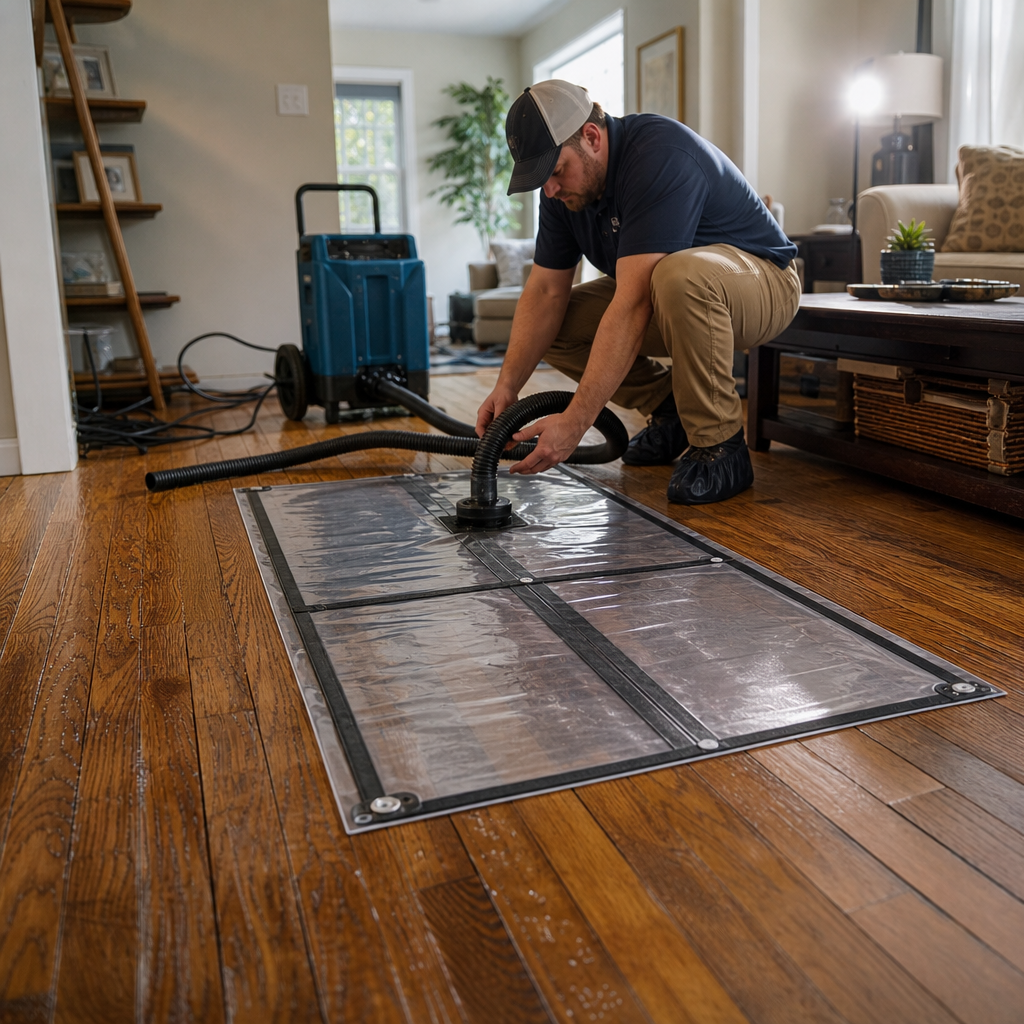
Specialized floor mat extraction systems seal directly over wet hardwood, applying high vacuum pressure to draw trapped water up through the plank seams and the subfloor beneath. Using negative-pressure extraction avoids the high expense of ripping up original flooring and preserves the structural integrity of your floor joists. Because floor replacement adds thousands of dollars to a project, rapid water extraction by teams like Floodline Restoration Co. remains the most cost-effective approach for property owners.
| Restoration Method | Standard Procedure | Financial Impact |
|---|---|---|
| In-Place Directed Mat Drying | Negative-pressure drying mats connected to high-vacuum extractors | Billed under standard mitigation rates ($3.00 to $7.50 / sq. ft.) |
| Complete Floor Replacement | Demolition of planks, subfloor removal, joist sanding, and rebuilding | Reconstruction billing ($25.00 to $40.00 / sq. ft.) |
When Structural Subflooring Requires Removal
Tear-outs become unavoidable when water sits undisturbed for multiple days, causing structural subfloors to delaminate or framing joists to show active fungal growth. Saturated fiberglass insulation beneath a floor acts like a heavy wet sponge, holding water against wooden joists. In those situations, technicians must remove the wet insulation and flooring materials from below to protect the structural stability of the building.
How Water Categories and Insurance Claims Shape Final Costs
The source of the water dictates safety requirements, disposal methods, and final cleanup costs. Standard Category 1 water (clean supply lines) requires standard mechanical extraction and drying. Category 2 gray water (washing machine overflows, dishwasher discharge) requires light sanitization. Category 3 black water (sewage backups, ocean water, or long-standing stagnant water) demands biohazard containment, antimicrobial application, and the controlled removal of porous materials.
Category 3 Biohazard Sanitization Expenses
Black water cleanups cost more per square foot because technicians must wear protective gear, establish negative-pressure containment barriers to protect unaffected rooms, run HEPA air scrubbers, and transport contaminated waste to approved disposal facilities. Delaying cleanup on clean water will also cause it to degrade into gray or black water within 24 to 48 hours as bacteria multiply, turning a simple extraction job into an expensive hazardous cleanup.
Navigating Property Insurance Coverage
Most standard homeowners policies cover sudden, accidental internal water damage, such as a ruptured copper pipe or a failed water heater valve. However, overland coastal flooding and municipal storm drain backups typically require separate National Flood Insurance Program (NFIP) policies or sewer backup endorsements. To help ensure your claim is paid without delays, proper documentation must include:
- Initial Thermal Imaging: Detailed moisture maps and photo documentation establishing the original water perimeter before any equipment runs.
- Daily Psychrometric Logs: Continuous tracking of temperature, relative humidity, and moisture content in wood and drywall to justify equipment runtime to insurance adjusters.
- Standard Itemized Billing: Clear line-item breakdowns matching industry-accepted restoration software, minimizing out-of-pocket friction for the property owner.
Frequently Asked Questions
How much does emergency water extraction typically cost?
Most residential emergency water extraction and structural drying jobs range between $1,200 and $5,000, averaging roughly $3,000. On a square-foot basis, extraction and drying cost between $3.00 and $7.50 per square foot depending on water contamination levels and structural saturation.
Does homeowners insurance cover water extraction and restoration costs?
Standard homeowners insurance policies generally cover sudden, accidental internal water discharge, such as a burst supply pipe or a frozen line. Damage caused by coastal storm surges, exterior surface flooding, or municipal sewer backups usually requires a dedicated flood insurance policy or a specific sewer and drain endorsement.
How is the cost of water extraction calculated per square foot?
Restoration companies like Floodline Restoration Co. calculate per-square-foot costs based on water depth, the contamination category (clean, gray, or black water), the types of materials affected (carpet, hardwood, concrete, or drywall), and the specialized equipment needed for extraction and dehumidification.
What factors increase the overall price of water removal?
The main cost drivers include delayed response times that lead to mold growth, water migration into shared party walls or subfloor framing, heavy biohazard contamination from sewage or storm runoff, and the need for structural demolition when materials cannot be dried in place.
How much does flooded basement water extraction cost?
Pumping standing water out of a flooded basement typically ranges from $1,000 to $4,500. If the basement is finished with drywall, carpeting, and insulation, or if the water is contaminated by sewage or ground runoff, comprehensive mitigation and structural drying can range from $3,000 to $10,000 or more.
What is the difference between water extraction and full water damage restoration costs?
Water extraction focuses on the immediate removal of standing liquid and active structural drying, which costs between $3.00 and $7.50 per square foot. Full restoration includes subsequent repairs, such as replacing drywall, installing new subflooring, rebuilding cabinetry, and repainting, which typically adds $20.00 to $37.00 per square foot.
Need water extraction cost?
We’re available now - call for a fast, free estimate.
Sources
- Restoration Cost Statistics (2026) – RapidEye – rapideyeinspections.com (2026)
- Water Damage Restoration Service Cost (2026 Pricing Guide) – insidercost.com (2026)
Related reading: Sewage Backup Cleanup Cost – 10% Off & Free Estimate – Same-Day Service
Related reading: Water Mitigation Cost – Call Now-10% Off – Same-Day Service – Free Estimate
Related reading: Sewage Cleanup Cost | 10% Off & Free Estimate | Same-Day Service
Frequently Asked Questions
How long does the water extraction and structural drying process take?
While active water extraction removes surface pooling in a few hours, complete structural drying typically takes three to five days depending on material saturation. Floodline Restoration Co. uses daily psychrometric monitoring to track moisture reduction in framing and masonry until materials reach industry-standard dry goals.
Do I have to pay out of pocket before my insurance claim is processed?
With Floodline Restoration Co.'s Straight Claim Program, technicians provide upfront written scopes using standard industry software and bill your insurance carrier directly. Most property owners are only responsible for their policy deductible while our team submits daily moisture logs directly to the adjuster.
How is hidden moisture detected in shared walls and masonry cavities?
Technicians use non-invasive thermal imaging cameras and structural moisture meters to identify water migrating through hollow brick cavities and shared timber joists. Floodline Restoration Co. offers free on-site visual inspections to map hidden moisture paths before structural framing deteriorates or mold develops.
About the author
 |
Sarah Miller Sarah Miller is a certified water damage restoration specialist with over eight years of experience serving the Canarsie, NY area. Holding a degree in Environmental Science from Brooklyn College, she specializes in emergency response protocols and navigating complex insurance claims for both residential and commercial properties. Her practical expertise helps property owners understand the nuances of restoration costs and effective prevention strategies. |
Water damage, flood, or mold emergency?
We’re available now - call for a fast, free estimate.
Call Now - Free Estimate