
Quick Summary
Water damage restoration in Brooklyn requires immediate mitigation within 24 to 48 hours to prevent severe mold colonization and structural decay inside dense brick party walls and timber joist pockets. Floodline Restoration Co. resolves these crises through a unified, single-source emergency model delivering 45-minute on-site dispatch, advanced structural cavity drying, and full insurance claims management without third-party subcontractors. Property owners will understand the exact steps required to halt catastrophic flood losses and can contact the 24/7 live dispatch line for rapid 45-minute emergency service and a free on-site visual inspection.
Water Damage Restoration Brooklyn: Fast Emergency Dispatch
When clean water, storm surge, or sewage floods your property, Floodline Restoration Co. provides fast, 24/7 emergency dispatch across Brooklyn. Technicians arrive on-site with extraction equipment and dehumidifiers to halt structural decay and dry your building. Brooklyn has substantial flood exposure, with 14,350 buildings predicted to be damaged in a 1 percent annual chance floodplain event. In our dense neighborhoods of attached brick brownstones and deep rowhouse basements, delay lets water seep deep into historic masonry party walls and structural joists.[3]
We manage water extraction, structural drying, and repairs. Call our live 24/7 dispatch line now for rapid local dispatch to your property for an on-site visual inspection.
Emergency Water Damage Restoration Brooklyn: Rapid On-Site Response
Emergency water damage response in brief: Professional water damage restoration in Brooklyn requires immediate extraction within 24 to 48 hours to stop wood rot, structural settling, and mold colonization. Restoration crews arrive on-site to remove standing water, dry shared party-wall cavities, and help return your property to pre-loss condition.[5]
When dealing with emergency water damage, Brooklyn homes and commercial buildings face severe risks within hours. The New York Fed identifies Brooklyn as having the highest quantity of households at risk of flooding in its tristate housing-market analysis. Because of shared walls and older foundations, standard suburban cleanup approaches are not enough. Floodline Restoration Co. responds quickly to stop water from traveling across structural framing and finished surfaces.[1]
Immediate Action Steps While Waiting for Our Crew
- Shut off the main water supply: Turn off the street shutoff or the interior main valve immediately to isolate broken pipes or plumbing fixtures.
- Turn off the electricity: Never enter a wet basement or room with standing water until the circuit breakers for that level are turned off.
- Call for professional water extraction: Contact our team for emergency flood cleanup services to keep moisture from wicking into adjacent structural framing.
- Document visible damage: Take quick photos and videos of water levels, soaked furniture, and damaged building materials for your records.
- Keep air moving safely: If the area is safe and dry, open interior doors, but avoid using consumer vacuum cleaners or placing regular household fans directly over contaminated floodwater.
Why Live 24/7 Human Dispatch Matters in a Crisis
In a middle-of-the-night emergency, automated phone menus and delayed callbacks cost valuable time. The New York Fed identifies Brooklyn as having the highest quantity of households at risk of flooding in its tristate housing-market analysis. When tides rise or a cold snap splits an overhead supply pipe, having a dispatcher answer your call ensures rapid local dispatch. Our team handles water extraction and structural drying without third-party handoffs.[2]
Emergency Water Damage Restoration
Professional water damage restoration Brooklyn demands a fast shift from bulk pumping to structural dehumidification. Immediate mitigation stops capillary moisture migration into historic masonry party walls, protecting floor joists and halting microbial growth behind plaster and drywall.
Rapid Water Extraction and Standing Water Removal
Flooding can cause substantial structural losses across Brooklyn neighborhoods. High-capacity vacuum units pull water out of flooded basements, subfloors, and commercial spaces. Getting fast water extraction stops standing water from soaking deep into subflooring and foundational footings.[4]
Moisture Mapping with Thermal Imaging and Moisture Meters
Surface water removal is only the first step. Moisture often stays trapped inside party-wall joist pockets and under wood flooring long after the surface appears dry. Technicians track hidden pockets of water using diagnostic tools:
- Thermal Infrared Cameras: Pinpoint evaporative cooling signatures inside finished walls and ceilings without opening every partition.
- Deep-Pin Moisture Meters: Measure moisture levels inside framing lumber, subflooring, and structural sill plates.
- Non-Penetrating Moisture Meters: Track surface moisture gradients across finished tile, plaster, and hardwood without damaging materials.
Flood Damage Restoration
Flood cleanup services required after severe coastal storms or overland flooding focus on halting contamination and stabilizing building foundations. Because storm surges force street runoff and bio-contaminants directly into porous masonry, standard surface fans cannot fix the problem. Fast structural drying is needed to protect the structural frame.
Handling Coastal Storm Surges and Flash Floods
Low-lying coastal areas face regular storm surges and flash runoff. When water pushes past ground-level entries or back-pit drains, Floodline Restoration Co. provides rapid local dispatch to help affected properties stabilize and dry structural components.
Managing Stormwater Contamination and Category 3 Water
Storm surges bring dirt, road oils, and bacteria into crawl spaces and finished rooms. Effective flood restoration follows a strict sanitation process:
- Bulk Category 3 extraction with heavy-duty disposal systems.
- Removal of unsalvageable porous elements like soaked carpet padding and deteriorated drywall.
- Antimicrobial washing across exposed studs, joists, and concrete footings.
- Targeted dehumidification to pull moisture out of historic brick and subfloors.
Mold Remediation and Prevention
Need water damage restoration brooklyn?
We’re available now - call for a fast, free estimate.
Professional mold remediation stops fungal colonies from establishing themselves behind walls, underneath hardwood flooring, and inside moist ceiling spaces. Acting quickly during a water loss prevents micro-organisms from spreading across wet drywall and wood framing within the critical 24 to 48-hour incubation period.
The 48-Hour Mold Incubation Window
Dormant mold spores require only moisture and an organic food source to germinate. Within 24 to 48 hours of initial water contact, spores begin forming visible colonies inside wall cavities and underneath baseboards. Immediate water mitigation drops indoor relative humidity, helping stop mold growth before it starts.
Containment Barriers, HEPA Filtration, and Antimicrobial Treatments
If mold is already present, our crew isolates the work zone to help prevent cross-contamination to clean areas:
- Physical Containment: Setting up sealed polyethylene barriers held under negative air pressure.
- HEPA Air Scrubbing: Continuous air filtration that captures airborne spores.
- Surface Remediation: Physical cleaning of structural framing followed by antimicrobial solutions.
- Moisture Verification: Documenting that materials have reached dry baselines before rebuilding begins.
Sewage Cleanup and Biohazard Decontamination
Sewage backups bring Category 3 black water full of harmful bacteria, parasites, and chemical contaminants right into residential basements and commercial floors. When heavy rain overloads municipal combined sewers, hazardous wastewater backs up through floor drains, requiring immediate containment and specialized decontamination.
The Hazards of Category 3 Black Water Backups
When municipal storm lines overflow, untreated sewage backs up into basement drains, fixtures, and sump pits. In attached homes, contaminated water quickly penetrates porous concrete slabs and brick foundation walls. Quick sewage cleanup is necessary to protect occupant health and stop contaminants from soaking deep into building assemblies.
Deep Sanitization, Odor Elimination, and Safe Waste Disposal
Floodline Restoration Co. handles hazardous sewage backups with dedicated sanitation procedures:
- Safe Extraction and Waste Handling: Technicians in personal protective gear extract waste and dispose of contaminated porous items according to regulations.
- Antimicrobial Disinfection: Applying sanitizers across affected foundation surfaces, concrete slabs, and structural studs.
- Air Scrubbing and Odor Neutralization: Air scrubbers remove airborne compounds and lingering odors.
Fire and Smoke Damage Restoration
Restoring a property after a fire requires soot removal alongside extensive water extraction. Fire suppression efforts introduce thousands of gallons of water into a building, which cascades downward through floorboards, saturating joist pockets and masonry cavities. Floodline Restoration Co. handles both water removal and soot decontamination.
Managing Secondary Water Damage from Firefighting Efforts
Fire hoses release massive quantities of water into structural fires. In multi-story brownstones and commercial properties, this water pools on upper levels and runs down into interior wall assemblies. Our team provides fast water extraction and drying alongside soot remediation to protect the building frame from rot and structural weakening.
Soot Removal, Structural Cleaning, and Odor Neutralization
Restoring fire-impacted properties involves an organized sequence:
- Immediate Water Extraction: Removing trapped water from joist spaces and low points.
- Surface Cleaning: Using HEPA vacuums and specialized sponges to wipe acidic soot from surfaces and structural beams.
- Deodorization: Air scrubbers and filtration equipment neutralize smoke odors trapped inside building materials.
Burst and Frozen Pipe Water Damage Repair
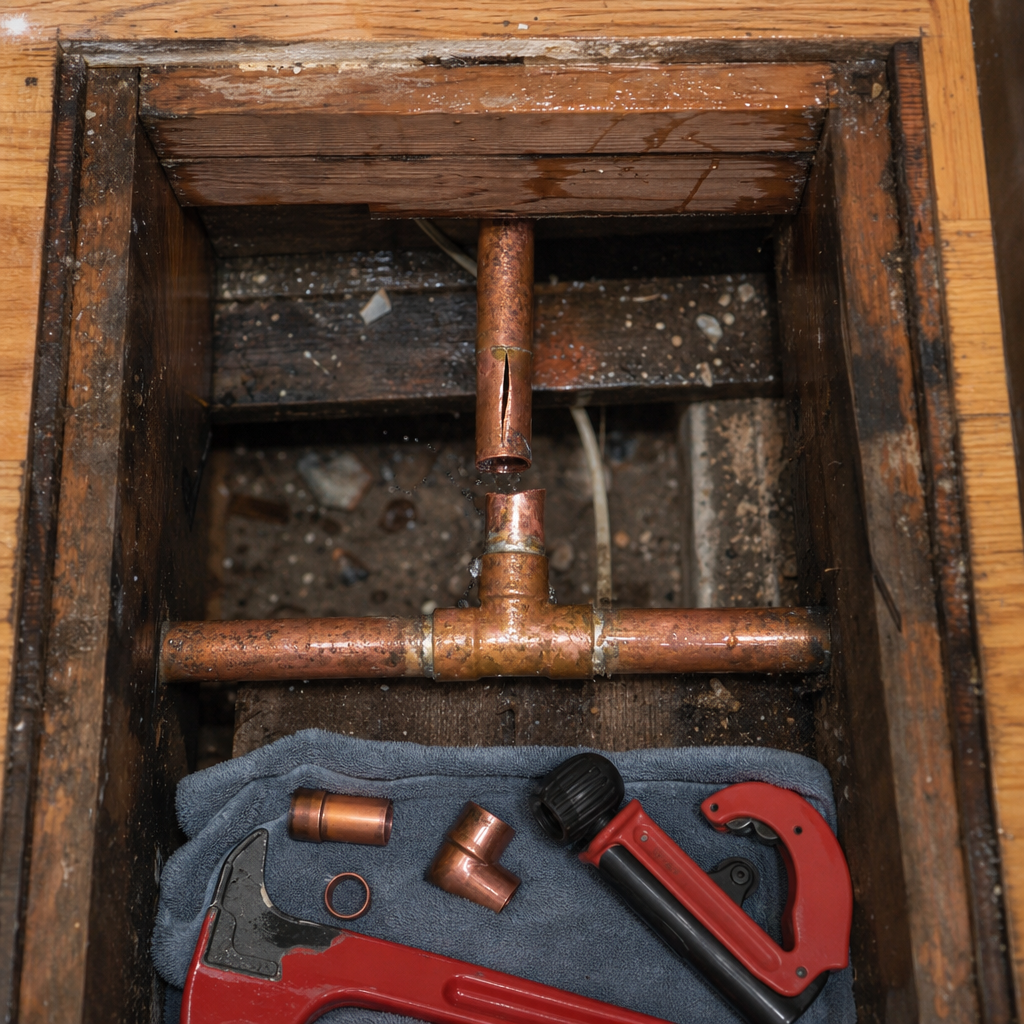
Repairing water damage from burst or frozen pipes requires fast leak isolation, moisture mapping, and structural cavity drying. When winter freezes crack uninsulated supply lines inside aging walls, water quickly travels through joist spaces before showing up on plaster or ceilings.
Winter Freeze Risks in Older Brooklyn Buildings
Uninsulated plumbing lines routed along exterior masonry walls are especially vulnerable during winter cold spells. As trapped water freezes, it expands and splits copper, brass, or galvanized pipes. Once the line thaws, pressurized water escapes directly into wall cavities and subflooring.
Cavity Drying Behind Plaster and Tile Walls
Rather than tearing out intact walls immediately, structural drying methods are used whenever possible:
- Detecting hidden water tracks behind walls using thermal imaging and moisture meters.
- Directing dry air into lath and plaster cavities.
- Circulating dehumidified air through enclosed framing spaces to dry structural timber in place.
Brooklyn Basement Flooding and Rising Water Tables
Basement flood cleanup in Brooklyn demands high-capacity water pumping to relieve hydrostatic pressure against foundation walls. Persistent groundwater can saturate concrete footings and brick walls, requiring mechanical water extraction before moisture wicks up into main-level framing.
Sub-Basement Inundation in High Water Table Zones
Neighborhoods near coastal inlets and low-lying ground deal with chronic high water tables. Shifting tidal levels push water through foundation cracks and basement slabs. Pumping setups and commercial dehumidification systems help stabilize foundation walls.
Sump Pump Failures and Perimeter Drain Overflow
When heavy rains knock out power or overwhelm primary sump pumps, perimeter drains overflow across finished basements. Floodline Restoration Co. provides rapid basement flood cleanup, deploying backup submersible pumps and generators to evacuate water, sanitize concrete, and dry structural assemblies.
Why Suburban Drying Fails: Historic Brick Party Walls and Joist Cavities
Need water damage restoration brooklyn?
We’re available now - call for a fast, free estimate.
Standard suburban drying techniques often fail in Brooklyn rowhouses, brownstones, and pre-war buildings. Generic restoration approaches simply place basic air movers in the middle of a room, assuming that moving surface air will dry the space. In Brooklyn architecture, this leaves hidden moisture trapped inside multi-wythe brick party walls and shared joist pockets.
Capillary Action and Moisture Wicking in Shared Masonry
Historic unsealed brick and lime-based mortar act like a sponge. Through capillary action, brick party walls draw water upward and outward, spreading moisture several feet away from the initial leak. Surface fans only dry the outer face of the plaster, leaving the deep masonry wet. Over time, that hidden moisture breaks down mortar joints and feeds mold inside wall cavities.
Pocketed Timber Joists and Concealed Structural Rot
In traditional Brooklyn construction, the ends of floor joists sit directly inside recessed pockets in the brick party walls. When water enters these pockets, there is little natural airflow to dry the wood. Moisture stays trapped around the joist ends, leading to hidden rot and structural sagging. Pressurized wall-cavity drying systems and dehumidifiers pull moisture directly out of masonry pockets to protect original timbers.
Parts and Components We Repair Across Brooklyn Properties
Floodline Restoration Co. inspects, cleans, dries, and repairs damaged structural elements to keep your recovery on track.
Drywall, Ceilings, and Lath-and-Plaster Systems
We evaluate whether wall assemblies can be saved or need removal. Saturated drywall with mold growth receives neat flood-cuts, while historical lath-and-plaster is dried in place whenever feasible using intra-wall drying.
Hardwood Flooring, Subflooring, and Structural Joists
We use specialty drying systems that pull deep moisture out of hardwood and subfloor layers, reducing cupping and crowning. When joists are affected, we dry the wood before repairs proceed.
Kitchen and Bathroom Cabinetry, HVAC Ducts, and Insulation
We dry built-in kitchen and bathroom cabinets using focused injection setups. Our team cleans HVAC ducts, removes contaminated insulation, and handles necessary drywall, trim, and finish work.
What Does Water Damage Restoration in Brooklyn Involve?
Water damage restoration costs and procedures depend heavily on the category of water, the affected square footage, and the degree of cavity drying required for historic masonry and joist pockets.
Restoration Factors Overview
Note: Restoration scope varies based on exact property conditions and contamination levels.
| Service Tier | Category 1 (Clean Water) | Category 2 (Grey Water) | Category 3 (Black Water / Sewage) |
|---|---|---|---|
| Contamination Level | Clean / Sanitary source | Significant chemical or physical contaminants | Grossly contaminated / Biohazards |
| Masonry Cavity Drying | Direct airflow systems | Pressurized cavity injection | Deep structural desiccant extraction |
| Sanitization Requirement | Standard drying | Antimicrobial application | Full biohazard decontamination |
Navigating Property Water Damage and Claims
Most standard property policies cover sudden, accidental water damage like burst pipes or appliance overflows, while overland flooding typically requires dedicated flood insurance. Floodline Restoration Co. assists property owners by compiling documentation, photo records, and moisture readings to support claim reviews.
Service Areas Across Brooklyn
Floodline Restoration Co. provides 24/7 flood restoration support across South, Central, and Eastern Brooklyn, offering rapid local dispatch with extraction equipment.
Serving Residential and Commercial Properties
We deliver residential and commercial water damage restoration across Brooklyn neighborhoods, including:
- Canarsie and Paerdegat Basin
- Flatlands and Marine Park
- Bergen Beach and Mill Basin
- East New York and Brownsville
- Flatbush, Midwood, and surrounding Brooklyn neighborhoods
Frequently Asked Questions About Brooklyn Water Damage Restoration
How quickly can emergency water damage technicians arrive in Brooklyn?
Our local crews provide rapid local dispatch across South, Central, and Eastern Brooklyn. Live dispatchers answer phones 24 hours a day, 7 days a week.
What factors determine the cost of water damage restoration in Brooklyn?
Costs depend on the water category, the extent of structural penetration, whether sewage is present, and the amount of structural drying needed for masonry and framing.
Does property insurance cover flood and water cleanup?
Standard policies generally cover sudden, accidental interior water damage, such as a burst pipe. Rising outdoor floodwaters and coastal surges typically require a separate flood insurance policy.
What is the difference between water mitigation and water restoration?
Water mitigation focuses on stopping ongoing damage through fast extraction, sanitizing, and structural drying. Water restoration involves repairing and rebuilding the damaged building materials to return the space to pre-loss condition.
How can mold growth be prevented following indoor water damage?
Mold prevention requires extracting standing liquid and reducing relative humidity levels within 24 to 48 hours. Applying antimicrobial treatments to structural wood framing and running dehumidifiers keeps dormant spores from germinating.
What should property owners do immediately while waiting for a restoration crew?
Shut off your property’s main water valve, turn off electricity to all flooded rooms at the breaker panel, take photos for records, and keep clear of standing water, especially if sewage backup or electrical hazards may be present.
How is hidden moisture verified inside older brick walls?
Technicians use infrared thermal cameras and moisture meters to check moisture levels inside brick party walls and enclosed joist pockets, ensuring every structural assembly is dry before repairs begin.
Need water damage restoration brooklyn?
We’re available now - call for a fast, free estimate.
Sources
- [PDF] Is New York City Ready for Rain? – NYC Comptroller's Office – comptroller.nyc.gov (2026)
- Is New York City Ready for Rain? – comptroller.nyc.gov (2024)
- Community Board Meeting: CB 18 Brooklyn – Presentation June 19, 2019 – nyc.gov (2019)
- [PDF] CITY OF NEW YORK, NEW YORK – NYC.gov – nyc.gov
- Ten Years After Sandy – New York City Comptroller – NYC.gov – comptroller.nyc.gov
Related reading: Water Damage Repair Pricing – Call Now-10% Off – On-Site in 60 Minutes – Free Estimate
Related reading: Water Extraction Cost Canarsie Ny | Call Now-10% Off | Same-Day Service | Free Estimate
Related reading: Free Water Damage Inspection Canarsie Ny | Call Now-10% Off | Same-Day Service | Free Estimate
Frequently Asked Questions
How does Floodline Restoration Co. streamline insurance claims without third-party handoffs?
Floodline Restoration Co. handles the entire claim documentation process in-house, submitting comprehensive thermal imaging logs, psychrometric drying reports, and itemized repair estimates directly to your carrier. This unified model eliminates billing discrepancies and project delays often caused by fragmented subcontractor networks.
Can historic brownstone materials like lath-and-plaster and hardwood floors be saved after flooding?
Yes, specialized intra-wall cavity drying and precision floor injection systems can restore historic lath, plaster, and hardwood without demolition. Floodline Restoration Co. uses non-invasive structural drying techniques to pull moisture out of deep brick party walls and pocketed joists, preserving original architectural integrity whenever safely possible.
What happens during the 45-minute emergency dispatch and free visual inspection?
Upon arrival within 45 minutes of your call, an IICRC-certified technician evaluates structural hazards, categorizes the water intrusion, and maps moisture migration using thermal imaging. Floodline Restoration Co. then provides a transparent action plan and can immediately begin high-capacity water extraction to prevent secondary damage.
About the author
 |
Sarah Miller Sarah Miller is a certified water damage restoration specialist with over eight years of experience serving the Canarsie, NY area. Holding a degree in Environmental Science from Brooklyn College, she specializes in emergency response protocols and navigating complex insurance claims for both residential and commercial properties. Her practical expertise helps property owners understand the nuances of restoration costs and effective prevention strategies. |
Water damage, flood, or mold emergency?
We’re available now - call for a fast, free estimate.
Call Now - Free Estimate