
Quick Summary
Unaddressed structural moisture and policy exclusions can cause the hidden costs of water damage restoration to escalate far beyond initial visual cleanup estimates. Floodline Restoration Co. helps property owners prevent unexpected expenses and claim disputes by providing advanced diagnostic moisture mapping, daily drying logs, and transparent project scopes. By understanding the critical differences between emergency mitigation and final reconstruction, readers can schedule a free visual inspection to secure an itemized, upfront restoration plan.
Hidden Costs of Water Damage Restoration: Avoid Claim Delays
When you walk into a flooded basement or find water pouring through a ceiling, the immediate instinct is to pump out the standing water and set up fans. Most property owners assume the financial cost will simply cover water extraction and replacing whatever drywall looks wet. In reality, total water or flood impacts can significantly exceed visible physical repair costs, stemming from concealed moisture behind surfaces, migration through shared building assemblies, and indirect financial burdens.[3]
According to Floodline Restoration Co., in attached brick and wood-frame buildings, water rarely stays confined to one room or even one property. Moisture migrates into shared party walls, wicks upward through plaster and wood framing, and pools under subfloors. If these issues are missed during the initial response, out-of-pocket expenses can escalate through delayed structural damage, complicated insurance claims, and remediation costs.[4] See also Water Damage Restoration Cost – 10% Off & Free Estimate – Same-Day Service.
Hidden Costs of Water Damage Restoration: What to Expect Upfront
The total price tag of an emergency water loss goes well beyond physical cleanup. An initial repair estimate based only on visible standing water often underestimates the full financial impact. Beyond direct building repairs, hidden and indirect costs frequently include business interruption, lost wages, temporary relocation, rental-income losses, disrupted goods and services, emergency-response costs, infrastructure damage, and uninsured or undercounted household expenses.[2]
Insured physical-loss estimates can understate broader economic impacts because they may exclude lost economic activity, emergency-response costs, and effects on businesses and households. For instance, a study by the USGS found that non-structural costs exceeded structural building damage at moderate Lake Champlain flood heights, while Zurich estimated average hidden household costs of about £3,280 per flood and £3,700 for severe flooding. On a broader scale, the Joint Economic Committee estimated 2023 U.S. flooding costs at $179.8 billion to $496.0 billion annually, including lost output, earnings, jobs, and business disruption.[1]
Key Realities for Property Owners
- Unseen structural moisture: Porous materials like wood framing, subfloors, and plaster can draw moisture upward through capillary action, expanding the scope of dampness above the visible waterline.
- Drying equipment and monitoring: Commercial drying equipment is typically billed based on run-time and monitoring requirements. If materials remain damp, extended operational periods can increase mitigation expenses.
- Mitigation versus reconstruction: Emergency mitigation (extracting water, removing damaged materials, and drying framing) is generally billed separately from the reconstruction phase (replacing drywall, painting, and installing new flooring).
The Real Drivers of Unexpected Out-of-Pocket Expenses
In semi-detached and attached buildings, structures share common structural framing and party walls. When a leak or heavy rain occurs, water can seep into shared floor joists and wall cavities. If moisture mapping is not performed across all adjacent cavities, dampness may linger and foster microbial growth.
Another major source of out-of-pocket expense involves insurance policy terms. Coverage varies by policy and may exclude or limit flooding, gradual leaks, seepage, mold, sewer backup, and related losses. When policies have specific limits, endorsements, or deductibles, property owners may be responsible for covering any remaining differences themselves.[5]
What Factors Influence Water Damage Restoration Costs?
Need hidden costs water damage restoration?
We’re available now - call for a fast, free estimate.
Final restoration costs depend on factors such as the water source and contamination level, the duration materials remain wet, building construction type, and the extent of required demolition and specialized drying.
Restoration Considerations by Water Category
| Feature | Clean Water (Category 1) | Grey Water (Category 2) | Black Water (Category 3) |
|---|---|---|---|
| Source Examples | Broken supply lines, overflowing sinks without contaminants | Washing machine discharge, dishwasher leaks, sump pump overflows | Sewage backups, rising floodwaters, storm surge, toilet backflows |
| Antimicrobial Treatment | Evaluated based on moisture levels and drying duration | Typically applied across affected contact zones | Thorough cleaning, sanitization, and containment protocols |
| Structural Moisture Risk | Can lead to secondary damage if drying is delayed | Potential absorption into subfloors and wall framing | Elevated risk with high potential microbial contamination |
| Material Removal | Often allows drying in place if addressed promptly | Selective removal of saturated porous materials | Removal of heavily contaminated porous materials |
Variables Influencing Final Restoration Billing
Time and water quality significantly influence total project scope. If standing water or moisture is left unaddressed, stagnant conditions and organic materials in building cavities can degrade water quality over time, increasing the need for containment, specialized air filtration, and demolition.
Contaminated water events, such as sewer backups or outdoor floodwater, also require additional safety precautions, specialized cleaning agents, and disposal procedures, which increase the overall labor and material handling requirements compared to clean-water mitigation.
Unseen Trapped Moisture in Drywall, Ceilings, and Party Walls
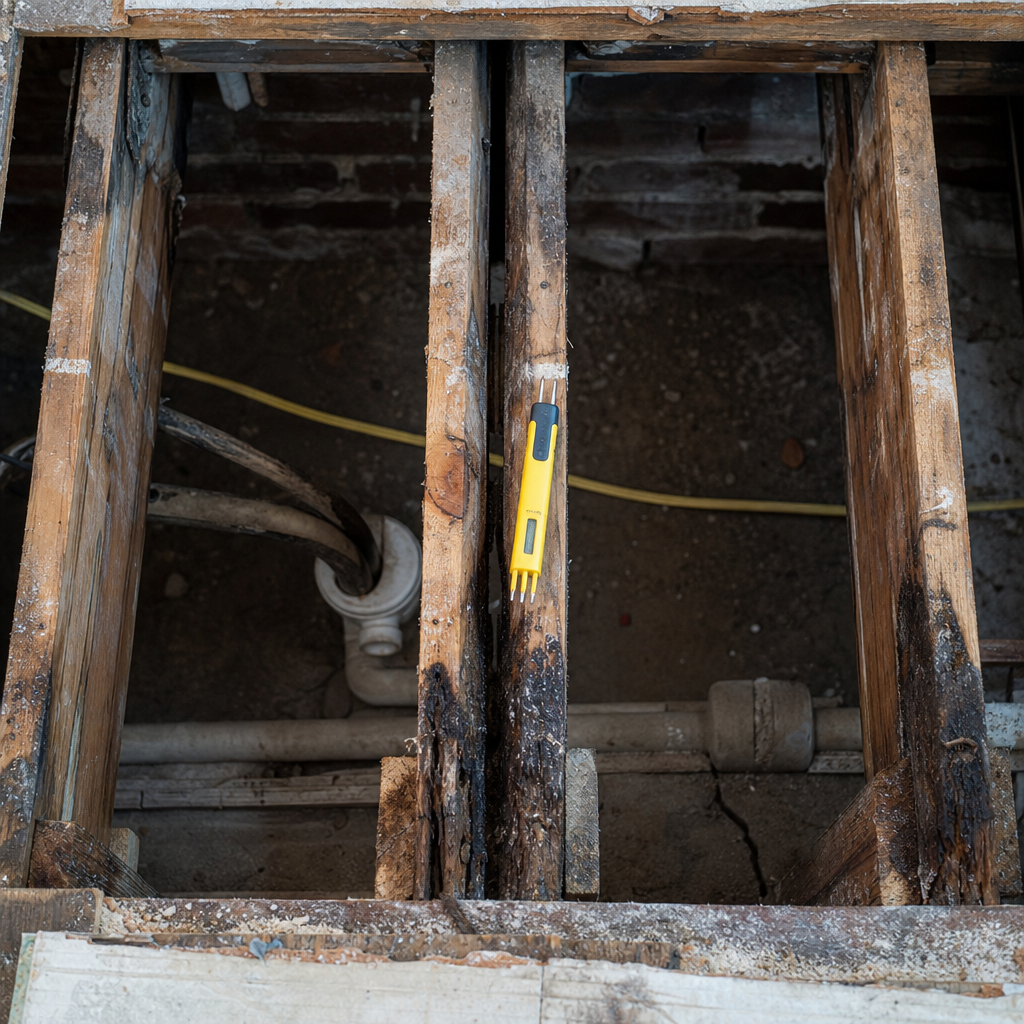
Visual inspections alone may not reveal whether structural assemblies are completely dry. Porous gypsum board, insulation, and timber framing absorb water, which can wick upward through capillary action. If only visible wet areas are removed while framing remains wet, moisture can stay trapped inside wall cavities.
Capillary Moisture Migration in Attached Buildings
In attached buildings, moisture can travel through shared assemblies, framing, and masonry joints across property lines. When water remains inside these spaces, building materials can degrade, fasteners can corrode, and odors may develop. Prematurely ending drying efforts can result in secondary damage and subsequent repairs.
Evaluation and Moisture Mapping for Saturated Assemblies
Restoration teams, such as Floodline Restoration Co., often utilize diagnostic procedures to document drying progress:
- Thermal imaging: Infrared cameras help locate temperature differentials that may indicate hidden moisture pockets.
- Moisture meter testing: Pin and pinless meters measure moisture levels in building materials relative to dry baselines.
- Psychrometric monitoring: Tracking ambient temperature, relative humidity, and specific humidity helps evaluate the drying environment.
Secondary Damage in Subfloors, Joists, and Basements
Need hidden costs water damage restoration?
We’re available now - call for a fast, free estimate.
Secondary damage can occur when moisture spreads beyond the initial intrusion area or when elevated humidity causes condensation on unaffected surfaces. Flooring materials can buckle, warp, or delaminate under prolonged moisture exposure.
Moisture Accumulation and Mold Considerations
When water penetrates beneath finished flooring, moisture can become trapped against subfloors. Without adequate airflow, trapped dampness can encourage mold growth over time. Remediating microbial growth beneath finished flooring may require removing surface materials to access and treat the subfloor.
Because coverage varies by policy and may exclude or limit mold and related losses, unaddressed moisture can lead to unexpected out-of-pocket expenses.
Contaminated Water and Porous Materials
When dealing with contaminated floodwater or sewer backups, restoration protocols generally focus on containment and material evaluation:
- Porous Material Evaluation: Heavily saturated porous materials that cannot be safely sanitized are typically removed and discarded.
- Sanitization and Containment: Containment barriers and air filtration help prevent the spread of dust and contaminants to unaffected areas.
- Structural Monitoring: Semi-porous framing and foundation materials are cleaned, sanitized, and monitored until dry targets are met.
Why Initial Restoration Estimates Differ from Final Invoices
Initial estimates may differ from final invoices when concealed moisture, additional affected materials, cause-of-loss questions, coverage limits, deductibles, exclusions, or protective repairs are identified during the course of work. Initial scopes often focus on immediate stabilization, while full assessments require access to underlying assemblies.
Equipment Usage and Drying Timelines
Drying timelines depend on building materials, ambient atmospheric conditions, and the extent of water penetration. Dense framing or high humidity can extend the drying cycle, affecting total equipment run-time and labor costs.
Practical Documentation Suggestions for Property Owners
To help maintain clear records during a claim, property owners and contractors may consider the following practical documentation suggestions:
- Daily Moisture Logs: Detailed moisture readings tracking progress toward baseline dry standards.
- Itemized Scopes: Clear separation between emergency mitigation services and subsequent repair or reconstruction estimates.
- Photo Documentation: Date-stamped photographs showing water levels, affected materials, and meter readings prior to and during removal.
Frequently Asked Questions About Water Damage Restoration Costs
Navigating the restoration and insurance process can involve several cost-related considerations. Here are answers to common questions.
How much does water damage restoration cost?
Total restoration costs vary widely depending on the extent of damage, the cause and category of water, insurance coverage terms, deductibles, policy exclusions, and the specific repairs required to stabilize and rebuild the property.
Does insurance cover commercial dehumidifier rentals?
Coverage varies by policy and may exclude or limit specific perils, equipment types, or drying procedures. Policies may cover necessary mitigation equipment when damage results from a covered loss, though insurers typically evaluate supporting drying logs and documentation.
Why do restoration quotes exclude complete structural rebuilding?
Emergency restoration focuses on mitigation and stabilization: extracting water, removing unsalvageable materials, and drying the structure. Rebuilding drywall, trim, and flooring is typically estimated as a separate repair or reconstruction phase once moisture levels are fully resolved.
Business Call to Action (independent of research findings): Hidden costs of water damage restoration add up when concealed moisture, secondary mold growth, and claim questions are left unaddressed. Contact Floodline Restoration Co. to schedule a visual inspection and receive an itemized scope of work for your property.
Need hidden costs water damage restoration?
We’re available now - call for a fast, free estimate.
Sources
- Flooding Costs the U.S. Between $179.8 and $496.0 Billion … – jec.senate.gov (2024)
- [PDF] Flooding Costs the U.S. Between $179.8 and $496.0 Billion Each Year – jec.senate.gov (2024)
- A review of recent advances in urban flood research – repository.library.noaa.gov (2023)
- Economic Value of Flood Forecasts and Early Warning … – repository.library.noaa.gov (2018)
- Climate-driven flooding widens economic inequalities across EU … – nature.com (2026)
Related reading: Floodline Restoration Co Canarsie – Call Now-10% Off – Same-Day Service – Free Estimate
Related reading: Homeowners Insurance Water Damage – Call Now-10% Off – Same-Day Service – Free Estimate
Related reading: Is Water Damage Covered By Homeowners Insurance – Call Now-10% Off – Same-Day Service – Free Estimate
Frequently Asked Questions
How do daily drying logs and moisture mapping protect against insurance claim disputes?
Insurance adjusters require objective proof that commercial drying equipment was necessary and operated only as long as structural standards demanded. Floodline Restoration Co. documents daily psychrometric readings and infrared moisture mapping to justify operational run-times, preventing insurers from denying line items or reducing claim payouts.
Who covers the restoration costs when water migrates through shared party walls in attached properties?
When moisture crosses party walls in semi-detached or attached buildings, costs are typically divided among neighboring insurance policies based on the proven point of origin. Conducting comprehensive diagnostic moisture testing immediately establishes the water source and migration path, protecting property owners from absorbing their neighbor's structural drying costs out-of-pocket.
How can property owners prevent unexpected expenses when concealed water damage is uncovered mid-project?
Unanticipated costs usually stem from contractors providing quick visual estimates that omit underlying subfloor and framing moisture. Property owners can avoid surprise bills by scheduling a visual inspection with Floodline Restoration Co. to obtain an itemized, transparent scope that clearly separates immediate emergency mitigation from subsequent reconstruction phases.
About the author
 |
Sarah Miller Sarah Miller is a certified water damage restoration specialist with over eight years of experience serving the Canarsie, NY area. Holding a degree in Environmental Science from Brooklyn College, she specializes in emergency response protocols and navigating complex insurance claims for both residential and commercial properties. Her practical expertise helps property owners understand the nuances of restoration costs and effective prevention strategies. |
Water damage, flood, or mold emergency?
We’re available now - call for a fast, free estimate.
Call Now - Free Estimate