
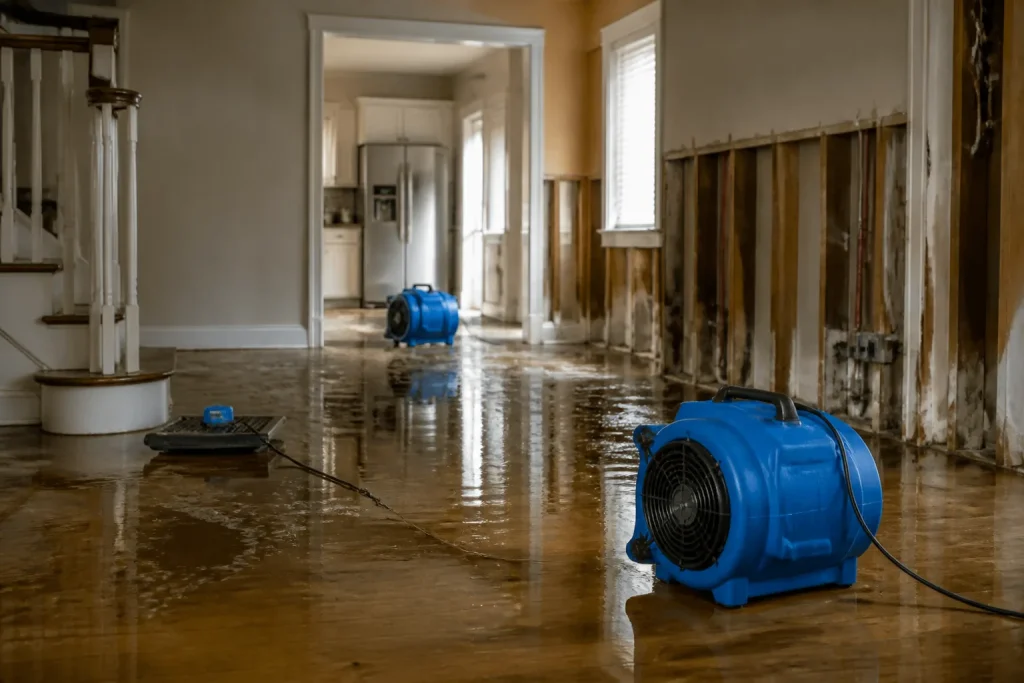
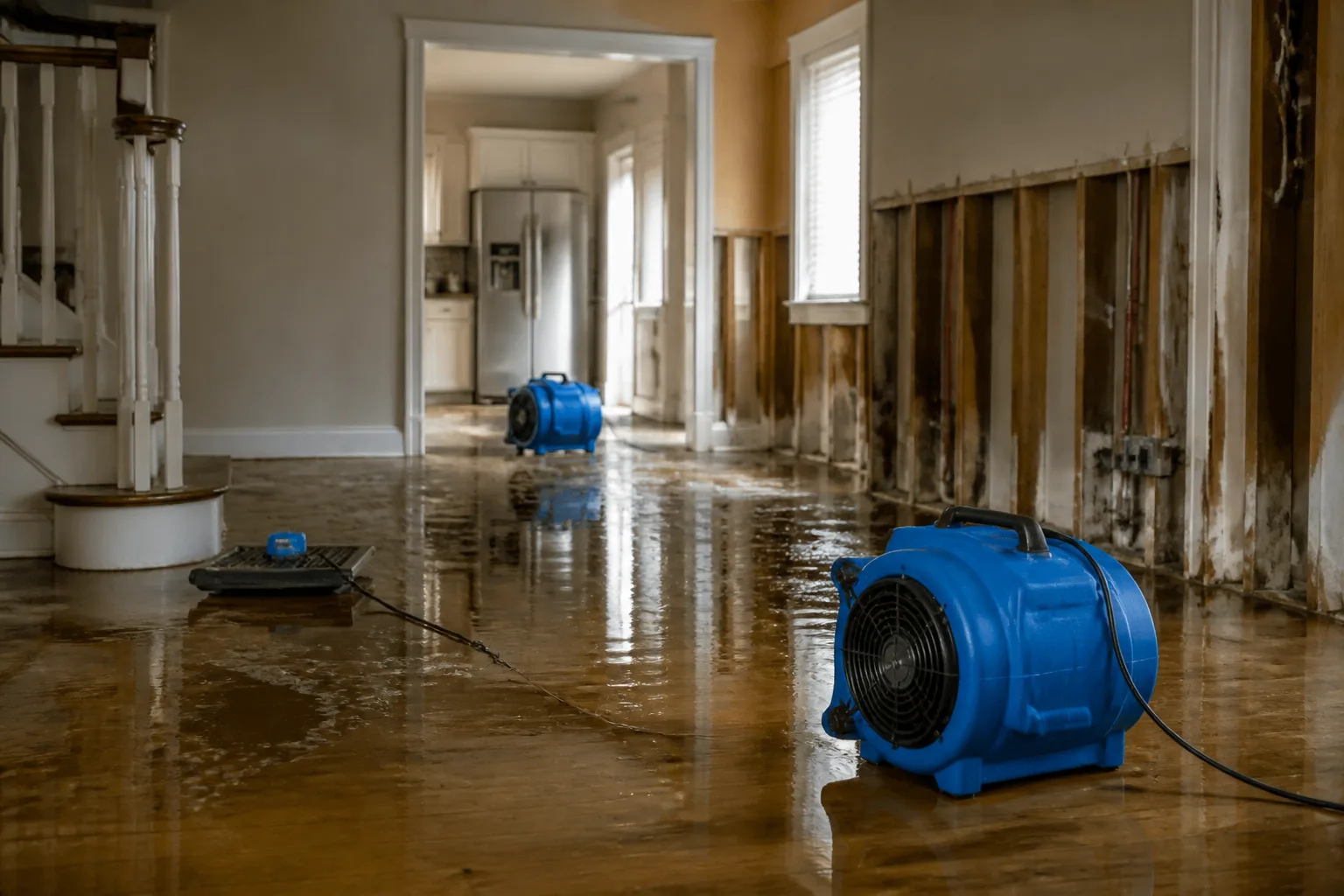
Emergency Water Damage Restoration Near Me: What Canarsie Homeowners Should Do First
If water is entering your Canarsie home right now, shut off the water source if you can do so safely, cut power to affected areas at the breaker, and call a restoration company that answers with a live person. The first 48 hours decide whether you’re dealing with a dry-out or a full mold remediation and rebuild. If you’d rather not handle the first steps alone, call (716) 412-2972 and a live dispatcher will walk you through them while a crew heads your way.
Mold colonization on wet drywall can begin in as little as 24 to 48 hours. That’s not a worst-case estimate pulled from a lab report. It’s the window we work inside every time we respond to a flooded basement off Avenue L or a burst supply line near Remsen Avenue. If you’re leaving a message with a restoration company at 11 p.m. and they don’t call back until 9 a.m., you may have already lost a third of your response window before extraction even starts. This guide is a sequenced action checklist for Canarsie homeowners, built to minimize secondary damage before a crew arrives.
Key Takeaways
- Shut off water and electricity first, in that order, and only if you can reach the shutoff safely.
- Document everything with photos and video before anything is moved or dried.
- Clean water (supply line, sink overflow) allows limited homeowner wet-vac use; sewage or street floodwater requires hands-off protocol.
- A genuinely 24/7 company answers with a live person, not a relay service that takes a message.
- In Canarsie, storms near Jamaica Bay and Paerdegat Basin can spike demand fast, so call early and verify dispatch before you wait.
The First 15 Minutes: Stop the Source and Kill the Power
The first decision you make in a water emergency is also the easiest to get wrong: you turn off the electricity before the water. Actually, you do both, but the order matters. Shut off the water source first if you can reach the valve without standing in water. If you have to step into a wet basement to reach the main shutoff, don’t. Cut power at the breaker first, from a dry location, then deal with the valve.
Older Canarsie homes, particularly the brick rowhouses and semi-attached two-families built from the 1920s through the 1960s, often have basement panels in configurations that predate modern code. Some panels sit low on the wall, near the floor, which means a flooded basement can put live circuits within inches of standing water. If your panel is below the waterline or you see water near it, do not touch it. Call a licensed electrician and a restoration company at the same time. We work with this exact condition on a regular basis. The breaker for the basement may also be labeled in a way that’s not obvious: “Cellar,” “Rec Room,” or an old tenant’s name instead of “Basement.” Flip the main if you’re unsure, provided the panel itself is dry.
Once the water is off and the power is cut, take a breath. The next 45 minutes are about documentation and phone calls, not moving furniture.
The First Hour: Document Before You Move Anything
Insurance carriers are not in the room when the water comes in, so the only record of what happened is what you capture. Before you move a single item, before you mop, before you set up a fan, take photos and video. Walk the affected area slowly, room by room, and film the waterline as it sits. The line the water left is where we start, and it’s also the starting point for your adjuster.
What to capture in the first hour:
- Wide shots of every affected room from two angles.
- Close-ups of the waterline on drywall, baseboards, and any wicking up furniture legs.
- Photos of standing water before you touch it, including depth if it’s visible against a wall or stair.
- The source: a burst pipe fitting, a backed-up floor drain, a failed water heater supply line.
- Serial numbers and model plates on damaged appliances, water heaters, and HVAC units.
- Video walkthrough with you narrating what you see: “Basement, northeast corner, water is about two inches deep, coming from the base of the water heater.”
Why this matters in Canarsie specifically: a carrier may argue that basement seepage was pre-existing or chronic, not sudden. That argument is harder to make when you have time-stamped photos shot within the hour. We also recommend writing down the time you first noticed the water and the time you shut the water off. Both go in the file we help you send to your adjuster. We bill the carrier directly, which removes the homeowner-as-messenger problem, but your documentation is still the foundation of the claim.
Which Water You Can Touch?and Which You Absolutely Cannot
Not all water is the same, and the difference determines whether you can start limited mitigation or should keep your hands off entirely. Restoration professionals classify water into three categories. What you need to know in the first hour is simple: clean water from a supply line gives you some room to act. Sewage, street flooding, or water that has been sitting for more than 24 hours does not.
Clean water comes from a broken supply line, a sink overflow, a tub left running, or a water heater tank that cracked without contaminating the water. In these cases, a homeowner with a wet-vac can begin extracting standing water while waiting for a crew. Sweep or squeegee water toward a floor drain if one is present. Do not use a regular household vacuum. Wet-vacs are built for water; household vacuums are not, and the result is worse than the flood.
Gray water comes from washing machines, dishwashers, or sump pump failures. It may contain soaps, food debris, or mild contaminants. Limited wet-vac use is acceptable if you’re wearing boots and gloves, but don’t delay professional extraction.
Black water is sewage, outdoor floodwater, or anything from a backed-up main line. In Canarsie, this is the category that matters most after heavy rain. Homes near Paerdegat Basin and the low-lying blocks east of Flatlands Avenue experience sewer backup when the municipal system surges. Street water that enters through a basement door or window is also black water, because it carries whatever was in the gutter and on the street. Do not touch it with your hands. Do not wet-vac it. Do not walk through it in open sandals. This water carries pathogens, and your first call should be to a company that handles Category 3 by protocol, with full PPE and controlled disposal.
When in doubt, treat the water as contaminated. The cost of professional extraction is always less than the cost of a hospital visit or a mold claim denied because contaminated water was spread into wall cavities by a homeowner’s fan setup.
How to Tell if a Restoration Company Is Actually 24/7
Here’s what happens with most restoration companies after midnight: you call, a service picks up, a friendly voice takes your information, and a technician calls you back in the morning. That’s not 24/7 service. That’s a 24/7 answering service pretending to be a restoration company. The distinction matters more than people realize, because the 48-hour clock doesn’t pause while you wait.
When you call a restoration company, ask these questions on the first call:
- “Am I speaking with a dispatcher who can send a crew, or an answering service that relays a message?”
- “Can you tell me roughly when a crew will arrive tonight?” A real dispatch desk gives you a window. A relay service says “someone will call you back.”
- “Will the crew bring extraction equipment on the first visit?” If the answer is no, you’re scheduling an inspection, not a response.
- “Are your technicians on shift right now or on call?” On-call means someone is being woken up and driving from home. On shift means a crew is already in a truck.
Floodline Restoration Co. runs a live dispatch board, not a message pad. The person who picks up at 2 a.m. is the same person routing trucks to your street. Extraction runs on the same visit in most cases. That’s the standard we built the company on, and it’s the reason we answer the phone with a person, not a recording.
The Canarsie Factor: When the Whole Block Floods at Once
Canarsie’s geography creates a problem most restoration guides never mention: demand spikes. When a storm pushes water up from Jamaica Bay or overwhelms sewers along the Paerdegat Basin corridor, dozens of homes flood in the same hour. Restoration companies with thin staffing get maxed out fast. Homeowners who waited for a callback at midnight may not hear back until the next afternoon, by which time the drywall has been wicking for 12 hours and mold is already setting in.
This is the real argument for calling early and verifying live dispatch. If your first-choice company can’t get to you within the hour, don’t hang up and wait. Ask when they can arrive, then call the next company on your list while keeping the first as a backup. If you’re in a storm surge event, have two or three names ready before the water ever enters: one for emergency extraction, one for backup, and your insurance agent’s after-hours number. In Canarsie, homes near the water are not the only ones that flood. Sewer systems back up blocks inland, and basements with older drain tile fail regardless of elevation. The block matters less than the storm’s duration.
We’ve pulled water out of a garage on East 92nd Street after a nor’easter where the homeowner’s first call had gone to a voicemail, and by the time they reached us the next morning, the damage had moved from a simple extraction into a two-week dry-out with baseboard removal. The water doesn’t wait. Neither should you.
The First 24 Hours: What a Proper Response Looks Like
Once a certified crew arrives, the sequence should follow a predictable pattern, and you should expect to see each step happen. If a company skips straight to setting up fans without mapping the moisture first, that’s a problem. Fans move air, but drying requires data.
A proper first 24 hours includes:
- Source verification: the technician confirms the water is off and identifies the failure point.
- Category assessment: clean, gray, or black water, with the appropriate protocol for each.
- Moisture mapping: thermal imaging and moisture meters establish the full footprint of the water, including what’s inside the walls. This is where professional-grade equipment like Dri-Eaz and Phoenix meters earns its keep. The water you can see is never all the water there is.
- Extraction: standing water is removed with truck-mounted or portable extraction units. On a single-family Canarsie basement, extraction usually takes a few hours, not days.
- Daily readings: the crew logs moisture levels every day until the structure hits the dry standard. You get that log. Your carrier gets that log. Nobody has to argue about whether it’s dry.
Most jobs are completed in a single visit when extraction is straightforward. Where drying takes longer, the same crew that read the moisture map on day one handles the daily readings. There’s no mid-job handoff to a different company, no “we do the water, someone else does the rebuild.” That matters in Canarsie, where many homes have original plaster and lath, and dry-down needs to account for materials that behave differently than modern drywall.
When to call a pro: any time water has touched drywall, insulation, or flooring for more than a few hours. If the affected area is larger than a single room. If the water is anything other than clean. If you can smell it. Water damage you can smell is water damage that has already begun the biological process. Call (716) 412-2972 and describe what you see. We’ll tell you honestly whether it’s a wet-vac situation or a crew situation.
Related services in Canarsie: Water Damage Restoration in Canarsie covers extraction through rebuild. If your flood happened more than a few days ago, Mold Remediation in Canarsie addresses what grows after the water is gone. And for damage that started with a kitchen or electrical fire before water was used to suppress it, Fire & Smoke Damage Restoration in Canarsie handles both systems, because the water often does more damage than the flame.
The Bottom Line
The first 48 hours after water enters your Canarsie home are the window where decisions determine the final cost. Shut off the source. Cut the power if you can do it safely. Document everything before you move it. Touch only clean water, and only with the right equipment. Call a company that answers with a live person and sends a crew with extraction equipment on the first visit. In a storm event near Jamaica Bay or Paerdegat Basin, call early and verify, because the whole block is calling too.
If you’re in Canarsie and need help, Floodline Restoration Co. home is built on a live dispatch board, not a sales desk. We answer the phone around the clock, send background-checked, uniformed technicians trained to IICRC, RIA, and IFA standards, and back every job with the 90-Day Done Right Promise, in writing. Our current offers, the $50 Off Any Repair Over $250, the $89 Seasonal Tune-Up, and the Senior & Veteran 5% Discount, apply to qualifying work. Call (716) 412-2972 for a free estimate on emergency water damage restoration in Canarsie. We’ll be there when we say.
Frequently Asked Questions
With Floodline Restoration Co., a live dispatcher answers your call at any hour and can route a crew to your street immediately. Extraction typically runs on the same visit, not a follow-up appointment. Call (716) 412-2972 and you’ll get a real arrival window, not a callback promise.
Most homeowners policies cover sudden and accidental water damage, like a burst supply line or a failed water heater. Sewer backup and storm surge coverage depend on the specific endorsements on your policy. We bill carriers directly and you never play messenger between us and your adjuster, but your first-hour documentation, photos, video, and written notes, is what protects the claim. Call (716) 412-2972 and we’ll help you work through what your policy covers.
For small, clean-water spills that haven’t touched drywall, a wet-vac and fans can handle the job. For anything larger than a single room, anything that’s reached drywall or insulation, or any water that isn’t clean, professional extraction is the cheaper long-term option. The mold that grows behind a baseboard after amateur drying costs more to remove than the extraction would have. Call (716) 412-2972 for an honest assessment, free of charge.
Do not touch sewage or street water with your hands, and do not attempt to wet-vac it. This is Category 3 water, meaning it carries pathogens, and it requires professional extraction with full PPE and controlled disposal. Shut off your power if you can reach the panel safely from a dry spot, keep everyone out of the affected area, and call (716) 412-2972. We handle Category 3 by protocol, including direct insurance billing.
Written by Curt Bowman, Owner at Floodline Restoration Co., serving Canarsie since 2010.
Need Damage Restoration Help?
Call Floodline Restoration Co. - licensed & insured, here with fast after-hours help in Canarsie.
(716) 412-2972