
Quick Summary
Canarsie property owners face severe risks from coastal storm surges, plumbing failures, and basement flooding near Fresh Creek and Paerdegat Basin that can trigger dangerous mold growth within 24 to 48 hours. Proper mitigation requires isolating electrical hazards, documenting losses for insurance adjusters, discarding saturated porous materials, and relying on Floodline Restoration Co. for all-in-one extraction, dehumidification, and structural reconstruction. Readers will understand immediate safety and cleanup procedures while knowing to call Floodline Restoration Co.'s 24/7 live dispatch for a rapid 45-minute emergency response and a free visual inspection.
How to Handle Water Damage, Mold & Flood Cleanup in Canarsie
Flooding in Canarsie has historically affected basements and ground floors, particularly in low-lying areas near Fresh Creek and Paerdegat Basin. According to the New York City Department of City Planning, approximately two-thirds of Canarsie is located in the federally designated 1% annual-chance floodplain, expanding from roughly 25 mapped buildings to 5,000 after revised mapping in 2013. When water enters homes, excess moisture can promote rapid mold growth.[1]
Remediating water and flood damage requires steady safety precautions. Saturated building materials must be addressed immediately: structures should be dried as quickly as possible, using fans and dehumidifiers only when electricity is confirmed safe, and wet materials that cannot be completely cleaned and dried must be removed. Property owners should seek qualified professionals like Floodline Restoration Co. for extensive flooding.
Immediate Steps Following Water or Flood Intrusion
Immediate steps in brief: Stay out of standing water and do not operate electrical equipment nearby until power is safely disconnected. Shut off the main water valve if dealing with a plumbing break, document all water lines and property damage with clear photographs, and keep children, pets, and people with compromised immune systems away from contaminated areas. Materials that cannot be thoroughly cleaned and dried within 24 to 48 hours must be removed to prevent mold growth.[5]
Electrical currents traveling through standing water create immediate shock hazards, while contaminated floodwater presents biological risks. Individuals must avoid entering standing water or handling powered devices in wet areas.
First Steps: Safety and Mitigation Checklist
- Cut Off Utilities Safely: Stay out of standing water and do not operate electrical equipment nearby. If the electrical breaker panel is located in a dry, accessible area, switch off power to submerged zones. If reaching the panel requires walking through standing water, contact an electrician or the utility provider immediately. Turn off the main water shutoff valve for plumbing leaks.
- Document Saturated Boundaries: Take photographs of standing water levels, waterlines, and affected personal property before moving items or pumping out water. This documentation serves as a record for insurance adjusters.
- Extract Water and Discard Porous Items: Keep children, pets, and people with compromised immune systems away from contaminated areas. According to FEMA, materials that cannot be properly cleaned and dried within 24 to 48 hours should be removed and discarded to stop mold growth. For extensive flooding, seek qualified professionals.
Paerdegat Basin, Fresh Creek, and Local Flood Factors
Flooding in Canarsie has historically affected basements and ground floors, particularly in low-lying pockets near Fresh Creek and Paerdegat Basin. According to the New York City Department of City Planning, approximately two-thirds of Canarsie is located in the federally designated 1% annual-chance floodplain. As a general professional practice, structures must be dried quickly using fans and dehumidifiers only when electricity is safe, and wet materials that cannot be completely cleaned and dried must be removed.[2]
Emergency Water Damage Restoration Protocols
In general professional practice, emergency water extraction stops moisture from spreading further into structural materials and helps prevent mold growth.
Rapid Extraction and Structural Drying
According to the New York City Department of City Planning, Canarsie contains roughly 12,000 residential buildings, with around two-thirds situated within vulnerable flood areas. In general professional practice, structural drying requires operating fans and dehumidifiers only when electrical systems are safe, drying materials as quickly as possible, removing materials that cannot be thoroughly cleaned and dried, and consulting qualified professionals such as Floodline Restoration Co. for extensive flooding.[4]
General Practice for Attached Buildings
In general professional practice, attached single-family and multi-family buildings require careful moisture evaluation across adjoining walls and shared structures. When water enters structural cavities, materials that cannot be completely cleaned and dried must be removed to prevent mold growth, and qualified professionals should handle extensive moisture migration.
Flood Damage Restoration and Storm Surge Recovery
Need How to Handle Water Damage, Mold & Flood Cleanup in Canarsie?
We’re available now - call for a fast, free estimate.
In general professional practice, floodwaters carry road runoff, sewage, and biological contaminants, requiring thorough sanitization alongside physical water removal.
Coastal Surges and Storm Inundation
According to data from the Federal Reserve Bank of New York, during Hurricane Sandy, 98% of Canarsie residents experienced some form of flooding, and at least one-third reported property damage. Following the storm, active flood-insurance policies across the neighborhood jumped 123% between 2012 and 2017. In addition, according to a Canarsie community flyer, floodwaters during Sandy reached 5 to 7 feet above grade in low-lying areas.[3]
General Sanitization and Material Removal Steps
In general professional practice, remediation following flooding involves the following procedures:
- Porous Material Removal: Wet materials that cannot be completely cleaned and dried must be removed and safely discarded.
- Cleaning and Disinfection: Exposed hard surfaces and structural framing are thoroughly cleaned and disinfected to neutralize biological contaminants.
- Structural Dehumidification: Structures are dried as quickly as possible using fans and dehumidifiers only when electricity is verified safe, and qualified professionals are engaged for extensive flooding.
Mold Remediation Standards
Damp conditions inside enclosed spaces can lead to rapid fungal growth. Effective mold remediation requires removing contaminated materials and permanently resolving the moisture source.
Moisture Control and Mold Prevention
According to FEMA, painting or caulking over mold does not stop mold growth. The underlying moisture problem must be corrected and all mold physically removed before repainting or completing repairs. According to FEMA, materials that cannot be thoroughly cleaned and dried within 24 to 48 hours must be removed and discarded to stop mold growth.
Protective Equipment and Safety Standards
According to FEMA, individuals handling mold-damaged materials should wear personal protective equipment, including gloves, protective eyewear, a filter face mask, long sleeves, long pants, and waterproof boots. Children, pets, and people with compromised immune systems must be kept away from contaminated areas. In general professional practice, qualified professionals such as Floodline Restoration Co. should be hired to address extensive mold or water damage, utilizing containment barriers and air filtration equipment.
Managing Sewage Backups and Drain Overflows
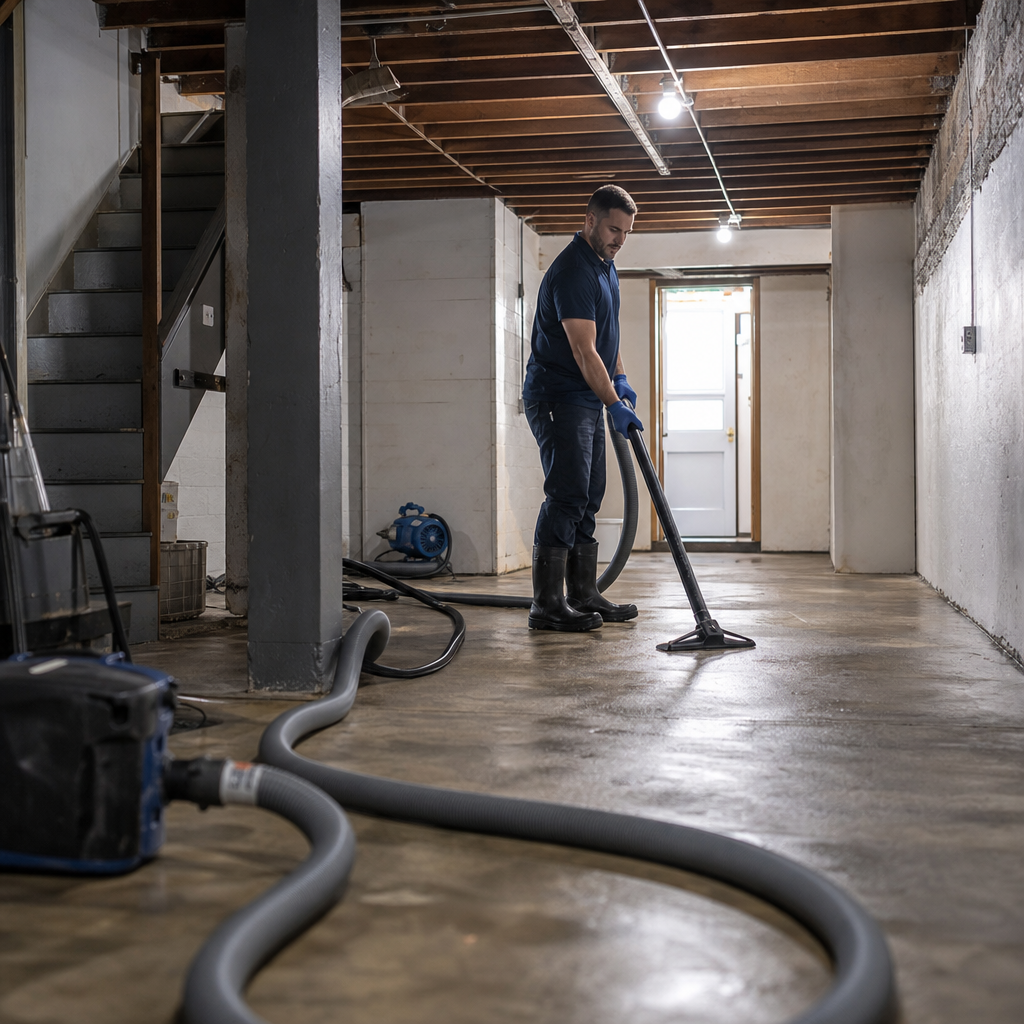
In general professional practice, municipal drain overflows and sewage backups present serious health hazards due to biological contaminants, bacteria, and viruses.
Health Hazards and Mitigation
Raw sewage contains hazardous pathogens. Children, pets, and people with compromised immune systems must be kept away from contaminated areas. Individuals should stay out of standing wastewater and not operate electrical equipment nearby until power is safely shut off.
General Sewage Cleanup Procedures
In general professional practice, sewage contamination is managed through specific protocols:
- Containment and Bulk Removal: The affected area is isolated, and standing wastewater is extracted safely without using electrical equipment in wet zones.
- Disposal of Contaminated Porous Goods: Porous materials that cannot be completely cleaned and dried must be removed and discarded.
- Cleaning and Sanitization: Non-porous surfaces are cleaned and disinfected, followed by rapid structural drying once electricity is confirmed safe.
Secondary Disasters: Pipe Breaks, Storm Damage, and Fire Recovery
Moisture damage can also result from internal plumbing failures, roof leaks, and firefighting operations.
Plumbing Leaks and Building Moisture
According to a New York State Senate report surveying 202 NYCHA residents, 52% reported leaks from roofs, windows, or pipes, and 59% reported finding mold. In general professional practice, plumbing failures require immediate shutoff of the main water supply, quick drying of saturated structures, and the removal of porous materials that cannot be fully cleaned and dried.
Roof Leaks and Storm Damage
In general professional practice, severe storms can compromise roofing materials, allowing rainwater into attic spaces, ceilings, and walls. Property owners must ensure power is safe before operating drying equipment, dry structures quickly, and seek qualified professionals like Floodline Restoration Co. for extensive structural damage.
Moisture Complaints and Cleanup
According to the New York City Department of Housing Preservation and Development (HPD), New York City recorded 31,135 mold-related indoor-allergen hazard complaints in fiscal year 2023, compared to 20,538 in fiscal year 2020. In general professional practice, water introduced during emergency events must be removed promptly, and structural components must be dried quickly to prevent mold growth.
Structural Components and Materials Commonly Repaired
Need How to Handle Water Damage, Mold & Flood Cleanup in Canarsie?
We’re available now - call for a fast, free estimate.
In general professional practice, restoration teams focus on cleaning, drying, and rebuilding primary materials exposed to moisture:
- Drywall, Ceilings, and Wall Insulation: Saturated drywall and insulation that cannot be completely cleaned and dried must be removed. Structural framing must dry completely before replacement materials are installed.
- Subfloors and Flooring: Moisture trapped under flooring materials requires prompt drying and ventilation once electrical systems are confirmed safe.
- Cabinets and Millwork: Saturated porous cabinetry that cannot be thoroughly cleaned and dried must be removed and replaced.
- Concrete Slabs and Foundation Walls: Concrete subgrades require rapid drying and dehumidification to remove trapped surface moisture.
Restoration Costs and Insurance Navigation
No reliable Canarsie-specific price is established for restoration projects. Costs vary by water type, contamination, affected materials, drying needs, and structural damage.
Navigating Insurance Coverage
Standard homeowners insurance generally does not cover most flood damage. Flood insurance generally covers direct physical flood damage, while coverage for moisture, mildew, or mold depends on the policy and cause. Property owners should document property damage thoroughly with photographs, maintain mitigation records, and contact their insurance providers promptly.
Serving Canarsie and Neighboring Brooklyn Communities
Flooding and water issues affect Canarsie and surrounding South Brooklyn neighborhoods:
- Bergen Beach and Flatlands: Residential areas requiring prompt extraction and structural drying following heavy rain events.
- Mill Basin and Marine Park: Coastal properties subject to tidal flooding and storm surges.
- East Flatbush and Brownsville: Residential communities requiring fast moisture mitigation and mold prevention.
Frequently Asked Questions
How quickly should cleanup and drying begin after water damage?
Mitigation must begin immediately once safety is confirmed. According to FEMA, materials that cannot be completely cleaned and dried within 24 to 48 hours must be removed and discarded to stop mold growth.
Can I clean up floodwater myself using household shop vacs and fans?
Individuals should stay out of standing water and not operate electrical equipment nearby until power is safely disconnected. While minor clean-water leaks can sometimes be addressed with household tools, property owners should seek qualified professionals like Floodline Restoration Co. for extensive flooding or contaminated floodwaters.
Does homeowners insurance cover flood cleanup and mold remediation?
Standard homeowners insurance generally does not cover most flood damage. Flood insurance generally covers direct physical flood damage, and coverage for moisture, mildew, or mold depends on the policy and cause.
What equipment is required to thoroughly dry a flooded basement?
In general professional practice, drying structures involves using fans and dehumidifiers only when electricity is confirmed safe, removing materials that cannot be completely cleaned and dried, and consulting qualified professionals for extensive flooding.
Need How to Handle Water Damage, Mold & Flood Cleanup in Canarsie?
We’re available now - call for a fast, free estimate.
Sources
- Resilient Neighborhoods – Canarsie – Department of City Planning – nyc.gov (2013)
- Canarsie Summary Report – nyc.gov (2017)
- Canarsie – nyc.gov (2013)
- NYC CDBG-DR Draft Action Plan Post-Tropical Cyclone Ida – nyc.gov
- [PDF] Canarsie Flyer – resilient neighborhoods – NYC.gov – nyc.gov
Related reading: Basement Flood Cleanup Cost – 10% Off & Free Estimate – Same-Day Service
Related reading: Professional Mold Removal Cost – Call Now-10% Off – Same-Day Service – Free Estimate
Related reading: Top Rated Water Damage Canarsie | Call Now-10% Off | Same-Day Service | Free Estimate
Frequently Asked Questions
How do attached homes in Canarsie prevent floodwater and mold from spreading to neighboring properties?
Because many Canarsie residences share structural cavities and party walls, moisture rapidly migrates between adjoining properties if not promptly contained. Floodline Restoration Co. provides rapid 45-minute emergency dispatch to evaluate shared wall framing, extract trapped water, and stop cross-building mold growth.
What should I do immediately to support my flood or water damage insurance claim in Canarsie?
Take detailed photos of standing waterlines, submerged structural areas, and damaged belongings before discarding items or pumping out water. Floodline Restoration Co. assists property owners by providing thorough moisture logs and damage assessments during a free visual inspection to streamline policy claims.
Can concrete slabs and structural framing be salvaged after a coastal storm surge or sewage backup?
Hard structural materials like concrete subgrades and framing can often be saved if biological contaminants are sanitized and moisture is dried within 24 to 48 hours. Floodline Restoration Co. manages the entire recovery workflow, from deep antimicrobial disinfection to industrial structural dehumidification and final rebuilds.
About the author
 |
Marcus Thorne Marcus Thorne is a certified restoration specialist with over a decade of hands-on experience in emergency water and mold mitigation. Drawing on a background in construction management from the New York Institute of Technology, he translates complex restoration procedures into actionable advice for property owners navigating unexpected damage. |
Water damage, flood, or mold emergency?
We’re available now - call for a fast, free estimate.
Call Now - Free Estimate