
Quick Summary
Sewage backups introduce hazardous Category 3 blackwater into properties, demanding rapid sewage backup cleanup to prevent severe biological contamination and structural decay across shared wall cavities. Effective remediation requires certified protocols involving pressurized biohazard extraction, controlled removal of porous materials, EPA-registered antimicrobial disinfection, and commercial structural drying. Readers will learn the critical steps for safely restoring contaminated spaces and how contacting Floodline Restoration Co. secures a 45-minute emergency response, a free visual inspection, and seamless insurance claim management.
Sewage Backup Cleanup: Emergency Removal and Remediation
When sewer water backs up into a property, every passing hour increases the scope of structural damage and biological risk. Raw sewage is classified as Category 3 blackwater, meaning it carries dangerous pathogens, viruses, bacteria, and toxic organic matter. Immediate, controlled sewage backup cleanup is necessary to stop wastewater from saturating porous building materials, migrating through party walls, and creating long-term structural contamination.[3]
While the U.S. Environmental Protection Agency (EPA) estimated in 2004 that between 23,000 and 75,000 sanitary sewer overflow events occur annually in the United States, that figure applies strictly to municipal overflows into streets, waterways, or general municipal systems, not individual household backups. In fact, a 2024 peer-reviewed review confirmed that the exact national volume and extent of household sewage backups remain unknown. What is clear on the ground is that local urban infrastructure failures directly impact private basements and lower levels, demanding rapid emergency response.[2]
Emergency Sewage Backup Cleanup: Immediate Steps and Fast Response
A sewage backup inside a finished basement, commercial ground floor, or shared utility room requires fast containment. Wastewater does not simply sit on the surface; it actively wicks into porous materials like concrete, framing, subflooring, and drywall.
What to Do in the First 30 Minutes
- Evacuate the area immediately: Keep children, pets, tenants, and non-essential personnel completely away from the backup zone.
- Cut off water and power if safe: Turn off the main water supply to stop incoming drainage. If the electrical panel is accessible without stepping into standing water, shut off power to the flooded rooms.
- Do not attempt standard DIY cleaning: Household vacuums, box fans, and over-the-counter bleach mops cannot extract biohazards from deep structural cavities. In fact, standard fans blow airborne pathogens across unaffected living areas.
- Call an IICRC-certified emergency team: Secure an on-site crew that can extract blackwater and establish negative air containment right away.
Why Urban Backups Are Rarely Single-Room Disasters
In attached residential brownstones, split-level homes, and commercial strips, treating an urban backup as a simple localized spill leads to hidden property decay. Category 3 blackwater spreads through capillary action, moving silently across shared party walls and shared floor joists into adjacent properties or neighboring apartments. Without immediate containment, one tenant’s backed-up drain can compromise framing across an entire building block.
What Does Sewage Backup Cleanup Cost?
Need sewage backup cleanup?
We’re available now - call for a fast, free estimate.
The cost of professional sewage backup cleanup varies widely based on water volume, contamination depth, how far moisture has migrated, and the amount of structural reconstruction required. Minor extractions isolated to unfinished concrete surfaces cost significantly less than multi-room disasters that require cutting out drywall, removing saturated subfloors, and sanitizing structural floor framing.
Primary Cost Drivers
- Standing Water Depth and Volume: Pumping out several feet of raw blackwater requires specialized truck-mounted extraction equipment and biohazard waste handling.
- Material Porosity: Unfinished concrete can often be decontaminated and dried, whereas particle board, carpet, pad, and drywall must be removed and safely discarded.
- Structural Wall Cavity Migration: When sewage wicks up behind baseboards and into shared wall cavities, crews must perform controlled removal and install specialized cavity-drying injectors, which increases labor and drying time.
- Clearance and Antimicrobial Treatments: Multi-stage disinfection using EPA-registered biocides and negative-air HEPA filtration.
Insurance Coverage Considerations
Standard homeowners and commercial property insurance policies typically exclude sewer backups unless a specific Water Backup and Sump Discharge endorsement has been added to the policy. Property owners should review their declarations page for specific limits, deductibles, and exclusions. Working with a restoration provider like Floodline Restoration Co. that supplies comprehensive moisture logs, itemized scopes of work, and photo documentation helps simplify the insurance claim process.[4]
Municipal infrastructure improvements can shift baseline risks. According to the New York City Department of Environmental Protection (2025), confirmed sewer backups in FY2025 reached a record low for both dry- and wet-weather days, with total sewer-backup complaints dropping 30% between FY2021 and FY2025, and confirmed dry-weather backups dropping 26%. However, heavy rainfall surges and localized blockages still regularly overwhelm neighborhood lateral lines.[1]
Basement and Crawl Space Decontamination: Slabs, Subfloors, and Framing
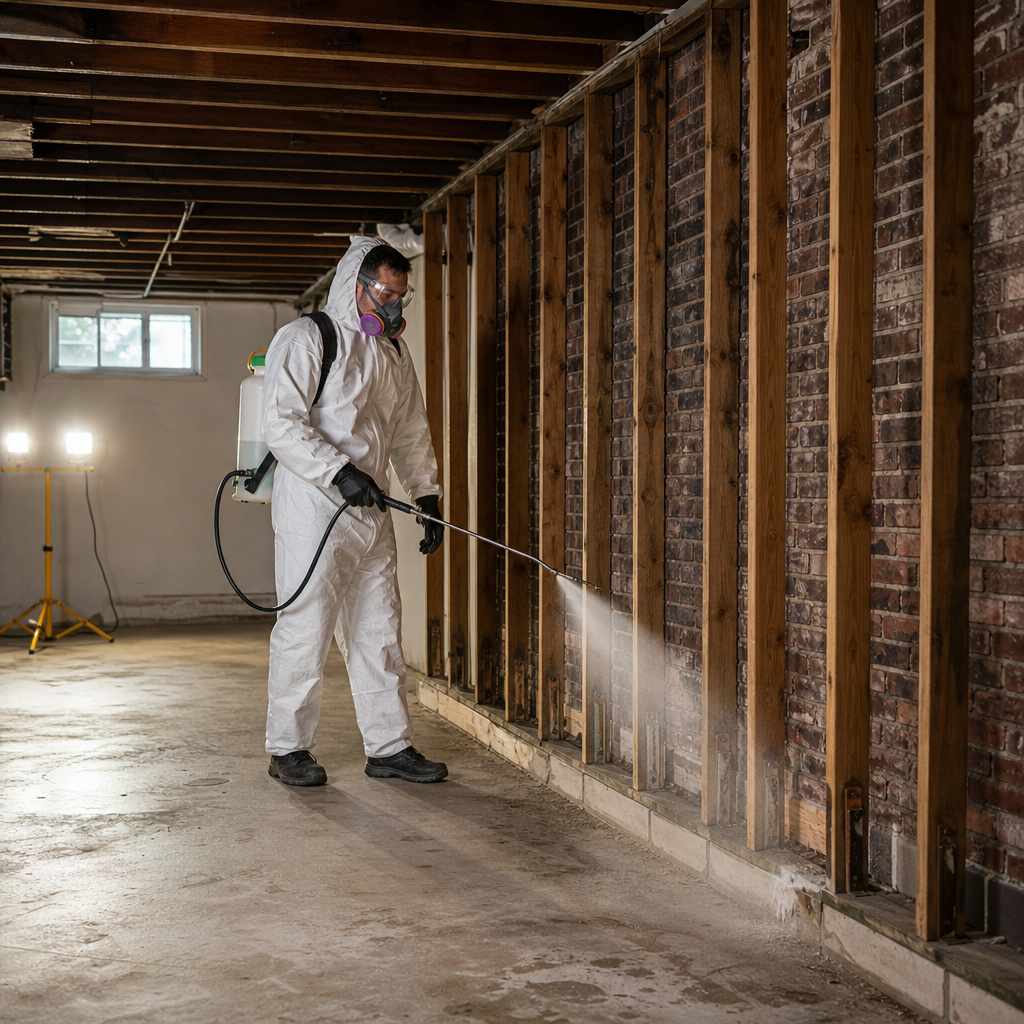
Basements and crawl spaces are particularly vulnerable during a backup because they sit at the lowest gravity point of the building drainage system. When city mains surcharge or main sewer lines clog with tree roots or debris, wastewater forces its way up through floor drains, basement toilets, and utility sinks.
Assessing Porous Concrete and Structural Timber
Concrete appears dense, but it is a porous, sponge-like material. When blackwater sits on a basement slab, bacteria, viruses, and moisture settle directly into the concrete’s micro-capillaries. Simply mopping up the puddle leaves dangerous pathogens and deep moisture trapped in the floor. Proper remediation by specialists like Floodline Restoration Co. requires pressurized extraction, heavy-duty industrial wash downs with broad-spectrum antimicrobials, and high-velocity commercial dehumidification to draw moisture out from within the slab.
Salvage vs. Disposal: Structural Materials
During Category 3 remediation, technicians must determine which building elements can be safely restored and which must be stripped out:
| Building Material | Remediation Action | Standard Protocol |
|---|---|---|
| Solid Structural Joists & Studs | Sanitize, Wash & Dry | Cleaned with biocides, hand-scrubbed, HEPA-vacuumed, and dried under monitored negative pressure. |
| Plywood Subfloors | Evaluate / Selective Removal | Thoroughly sanitized if delamination has not occurred; removed if sewage penetrated core plies. |
| OSB, Particle Board & Laminate | Remove & Dispose | Porous glues absorb pathogens and swell; impossible to safely decontaminate once saturated. |
| Drywall & Fiberglass Insulation | Flood Cut & Dispose | Cut 12 to 24 inches above the highest moisture mark to eliminate wick paths and expose studs. |
| Carpets, Tack Strips & Padding | Biohazard Disposal | Double-bagged and removed immediately in accordance with local biohazard disposal guidelines. |
Drywall, Party Walls, and Shared Multi-Family Cavities
Need sewage backup cleanup?
We’re available now - call for a fast, free estimate.
In densely built neighborhoods, attached single-family homes and multi-unit apartment buildings share common structural party walls. These party walls present a severe risk during a sewer backup.
The Danger of Party-Wall Capillary Action
When sewage floods a basement or ground-floor unit, it does not stop at the baseboard. Drywall, plaster, sill plates, and insulation act like a wick, pulling contaminated water upward and sideways through capillary action. Blackwater can travel several feet through shared wall cavities, contaminating the framing of an adjacent, attached property where no water is visible on the floor.
Warning signs of hidden party-wall contamination include:
- Softening or swelling along common partition drywall.
- Peeling paint or bubbling wallpaper near baseboards on shared walls.
- Foul sewer odors rising from electrical outlets, switch plates, or baseboard joints in adjoining rooms or neighboring units.
- Unexplained humidity spikes in adjacent apartments or basements.
Containment and Controlled Demolition
To keep contamination from spreading into unaffected living spaces, technicians establish negative air pressure using HEPA-filtered air scrubbers. Crews then perform a precision “flood cut,” removing drywall at least one to two feet above the highest detected moisture reading. Thermal imaging cameras and non-invasive moisture meters track the path of hidden moisture through party-wall voids, ensuring no damp, contaminated cavities are sealed back up.[5]
The Professional Sewage Cleanup Protocol: From Extraction to Sanitization
Restoring a home or commercial building after a blackwater disaster follows strict biological and structural standards to guarantee the space is safe for occupancy.
Step 1: Emergency Biohazard Extraction
Crews from Floodline Restoration Co. deploy commercial truck-mounted or industrial portable extraction units to rapidly pull standing wastewater and solid waste from the building. Removing bulk water immediately stops the continuous capillary flow into surrounding framing.
Step 2: Controlled Demolition and Containment
Non-salvageable materials (saturated drywall, insulation, trim, and porous flooring) are carefully removed, sealed in heavy-gauge biohazard bags, and hauled away. Negative air machines prevent airborne contaminants from drifting into clean areas of the property.
Step 3: Two-Stage Sanitization and Deep Disinfection
Decontamination requires a disciplined two-step chemical treatment:
- Initial Washdown: Application of an EPA-registered detergent and bactericide to strip away surface bio-load, dirt, and organic matter.
- Deep Antimicrobial Treatment: Pressurized application of hospital-grade biocides or botanical antimicrobials across bare masonry, floor joists, wall plates, and cavity voids to eliminate microscopic pathogens and prevent mold germination.
Step 4: Industrial Dehumidification and Structural Drying
Commercial Low Grain Refrigerant (LGR) or desiccant dehumidifiers work alongside high-velocity axial air movers to pull deep moisture out of solid wood framing and concrete floors. Daily moisture readings and psychrometric logs track the drying curve until all materials meet pre-loss moisture equilibrium.
Frequently Asked Questions About Sewage Cleanup
How much does professional sewage backup cleanup cost?
Cleanup costs depend heavily on the affected square footage, the depth of standing blackwater, and how many porous materials must be removed. A minor, localized backup on an unfinished concrete floor costs significantly less than a finished basement requiring drywall cuts, subfloor removal, and multiple days of industrial dehumidification.
Is sewage cleanup covered by homeowners insurance?
Standard insurance policies typically do not cover sewer backups unless you have added a specific Water Backup of Sewer or Drain endorsement. If you have this coverage, your policy helps pay for extraction, decontamination, and structural rebuilding up to your endorsement limit, minus your deductible.
Is it safe to clean up a sewage backup myself?
No. Category 3 blackwater contains dangerous biological hazards, including E. coli, Salmonella, Hepatitis A, and parasitic organisms. Standard protective gear and household cleaning chemicals are insufficient to safely treat deep structural saturation, and improper drying methods risk toxic mold growth inside closed wall assemblies.
What health risks are associated with raw sewage in a home?
Direct contact with raw sewage, or breathing in aerosolized biological particles, can lead to severe gastroenteritis, skin infections, respiratory illnesses, and blood-borne infections. Anyone experiencing symptoms such as fever, nausea, vomiting, or skin rashes after exposure should seek medical evaluation promptly.
How long does the sewage extraction and sanitization process take?
The initial emergency extraction, demolition of damaged materials, and deep chemical sanitization are usually completed within 24 to 48 hours. Structural drying using industrial dehumidifiers, as noted by Floodline Restoration Co., typically requires an additional 3 to 5 days, depending on the density of the concrete and framing.
What causes a sewer line to back up into a basement or drain?
Sewage backups are generally caused by severe municipal main surcharges during heavy rainstorms, tree root intrusion into private lateral lines, structural collapse of older sewer pipes, or heavy blockages from grease, fat, and non-flushable items lodged in the line.
Need sewage backup cleanup?
We’re available now - call for a fast, free estimate.
Sources
- [PDF] A Plan to Prevent Confirmed Sewer Backups – NYC.gov – nyc.gov (2025)
- 2004 EPA CSO SSO Report to Congress: Appendix G National Estimate of SSO Frequency and Volume – www3.epa.gov (2004)
- Brochure: Sanitary Sewer Overflows – What are they and how can we reduce them? – www3.epa.gov
- Find Sources – LCC Library – Lane Community College – library.lanecc.edu
- Baltimore's sewage system is hit hard by extreme weather – wypr.org (2024)
Related reading: How Long Does Mold Remediation Take | Call Now-10% Off | Same-Day Service | Free Estimate
Related reading: Mold Remediation Cost – 10% Off & Free Estimate – Same-Day Service
Related reading: Damage Restoration Companies – Call Now-10% Off – Same-Day Service – Free Estimate
Frequently Asked Questions
How quickly can emergency crews respond to stop sewage spreading into shared walls?
Floodline Restoration Co. dispatches certified in-house technicians within 45 minutes to halt capillary migration and extract blackwater before it compromises structural framing. Contacting the 24/7 live dispatch team secures rapid containment alongside a free on-site visual inspection.
How do restoration professionals help navigate the sewage backup insurance claim process?
Because sewage cleanup often depends on specific policy endorsements, technicians compile detailed moisture logs, itemized scopes of work, and photo documentation for your adjuster. Floodline Restoration Co. manages the entire claim process to ensure seamless communication with your insurance provider.
How is a building verified as safe for occupancy after Category 3 blackwater remediation?
Safety clearance requires multi-stage disinfection with EPA-registered hospital-grade antimicrobials and verified structural drying. Technicians utilize thermal imaging and non-invasive moisture meters to confirm that subfloors, concrete, and wall cavities have reached pre-loss moisture equilibrium before rebuilding.
About the author
 |
Marcus Thorne Marcus Thorne is a certified restoration specialist with over a decade of hands-on experience in emergency water and mold mitigation. Drawing on a background in construction management from the New York Institute of Technology, he translates complex restoration procedures into actionable advice for property owners navigating unexpected damage. |
Water damage, flood, or mold emergency?
We’re available now - call for a fast, free estimate.
Call Now - Free Estimate